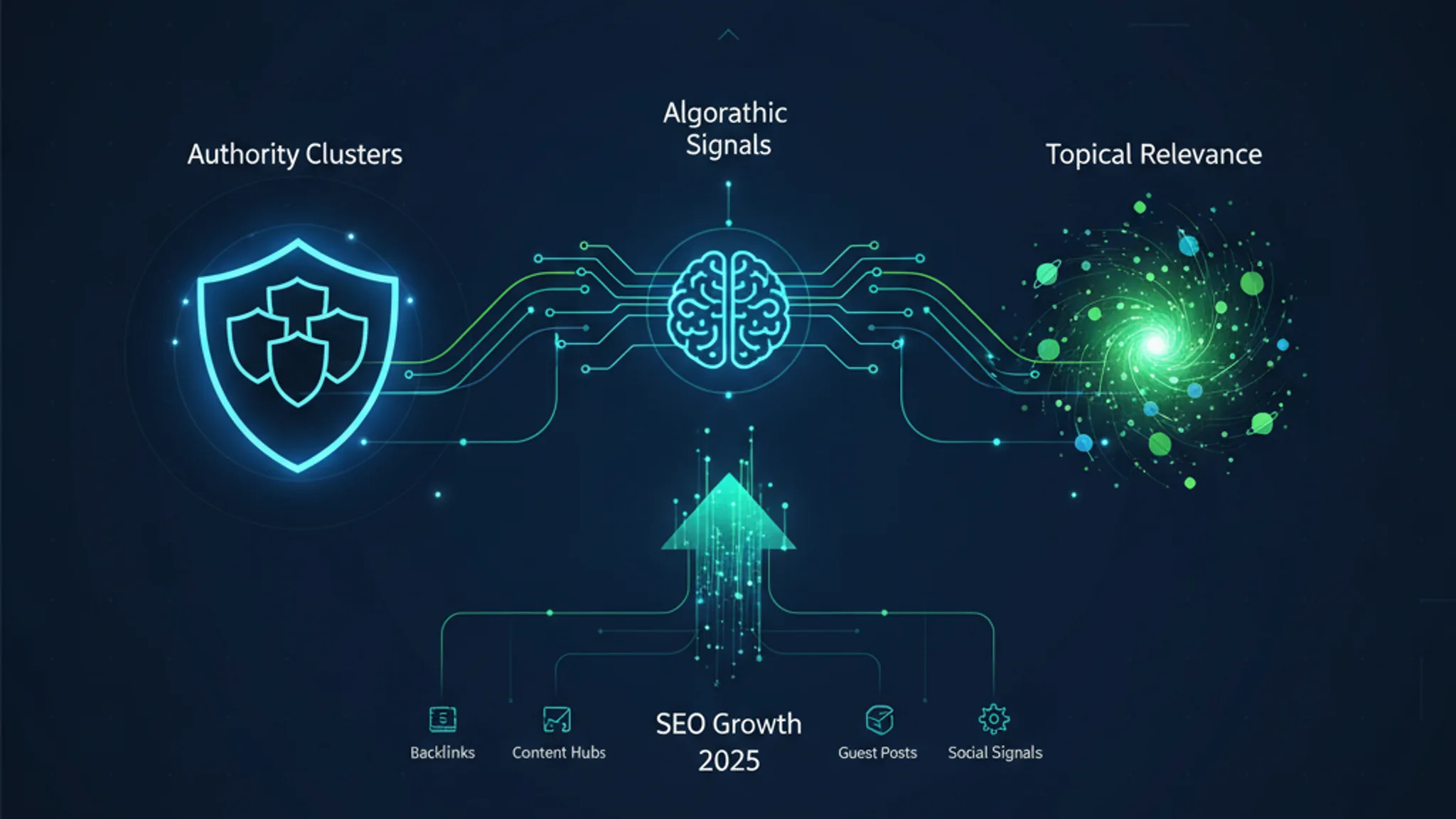
Twenty Ways to Build Links That Algorithms Respect
Twenty Ways to Build Links That Algorithms Respect
Most link building articles focus on tactics. This one is different.
Link building remains critical for 2025 rankings, but the strategies that work have fundamentally changed. The 2024 Helpful Content Update actually increased the importance of authoritative links—Google now measures the authority they represent, not just their presence. Here's what matters: Google doesn't count links anymore. It measures the signals those links send about your topical authority.
I've spent a decade watching what works. Quality link profiles beat quantity. Authority signals beat domain authority metrics. Algorithmic respect beats clever tactics. This guide focuses on strategies that signal real authority—the kind that survives algorithm updates and compounds over time.
1. Topical Authority Clustering: Build Links Within Your Niche
Google's algorithm now prioritizes topical authority—your depth within a specific subject area. A link from a site focused on your industry sends a stronger signal than a high-DA generalist site. When building links within your niche, you're directly signaling topical authority. The calculation is straightforward: if sites in your exact topic cluster link to you, you're an authority there. Target 70% of links from topically aligned sources, 30% from broader authority. This builds sustainable signals.
2. Broken Link Building: Authority Transfer
Broken link building works because it targets existing authority structures. When a site has a broken link pointing to relevant content, that site invested in that topic. The signal is clear: that site still has authority in your niche, and a fresh link continues that signal. Expect 30-40% acceptance rates from quality opportunities. Time-to-ranking: 60-90 days when topically relevant. The key variable is relevance—a broken link from a non-topical site has minimal value.
3. Expert Resource Pages: Authority Recognition
Resource pages consolidate a site's best recommendations. When your site appears there, you're receiving an authority-to-authority signal. Google weighs this heavily under E-E-A-T ranking factors—if an expert recommends you, you must be expert too. Evaluate resource pages before pitching: expertise credentials, host site authority, link quality standards. The algorithmic value compounds with each quality resource page link. This strategy excels in competitive niches where E-E-A-T signals outrank traditional metrics.
4. Digital PR: Third-Party Authority Endorsements
Journalist links are third-party endorsements that algorithms trust. Success requires newsworthy angles—original research, data-backed insights, or industry firsts. Benchmark: expect 1-2 press mentions per 10 quality pitches, with 70% generating links. Hit rates are lower because you're competing for editorial attention, but quality is massive—a major publication link is worth 5-10 typical business links. Time-to-ranking: weeks, due to authority transfer and freshness bonuses.
5. Competitor Link Gap Analysis: Smart Authority Targeting
Competitors have already identified topical authorities. When 20 competitors link from the same site, that site has proven topical authority bias. Don't just target high-DA competitor links—filter for relevance. Non-topical high-DA links give minimal signal. Focus on relevance-filtered gaps: authorities linking to competitors but not you, in your exact topic cluster. This takes longer but yields dramatically higher algorithmic returns by leveraging proven authority structures.
6. Guest Posting: Platform Authority Matters
Not all guest posts are equal. A post on a topically relevant, authoritative site with editorial standards sends strong E-E-A-T signals. Content farm posts send red flags. Selection matrix: Does the host site's content rank for competitive keywords? Does their audience overlap yours? Are their existing backlinks quality sources? Quality platforms see 2-3 month time-to-ranking because guest posts signal you were vetted by another authority. Expect 1 quality opportunity per 3 premium publication pitches.
7. Skyscraper Technique: Superior Content Earns Links
This works by combining content quality and topical depth. Create demonstrably better content than existing rankings—more comprehensive, recent, better-structured, data-backed. The calculation: if multiple sites link without pitching, it's genuinely useful. Natural links signal stronger authority than earned links. Monitor velocity post-publishing—typically 20-30% of eventual links arrive within 90 days from organic discovery. That pattern signals fast trust accumulation to Google's algorithm. You need 25%+ quality improvement over current rankings to justify the promotional effort.
8. HARO and Expert Quotes: Brand Authority Building
HARO links are journalist endorsements. When your quote appears in coverage, you're recognized as an expert. Journalists vet sources before publishing; Google knows this. Editorial standards transfer credibility. Benchmark: 1-2 published quotes per 20 responses. Improve to 3-5 by providing specific case studies and data. The brand authority benefit often exceeds the link value—your brand appears in authority publications, compounding topical authority signals even without hyperlinks.
9. Unlinked Mentions to Links: Citation Signal Conversion
The 2024 HCU revealed something crucial: Google measures co-citation signals alongside links. Brand mentions on authority sites without hyperlinks signal topical authority nearly as strongly as links. Monitor brand mentions across industry publications. Find high-authority mentions without links. Reach out, thank them, ask if they'd add a link since you've developed more resources. Conversion rate: 15-25% of quality mentions. The algorithmic value matches earned links because content is already published and trusted.
10. Link Velocity: Building at Natural Pace
Natural link growth follows patterns. Your baseline might be 5-10 links monthly. Sudden jumps to 50+ trigger algorithmic red flags. Manage velocity to match your niche baseline—competitive niches: 20-40/month, narrow niches: 5-15/month. Benchmark data: steady-pace acquisition yields 2-3x faster ranking acceleration than spike patterns. Consistent velocity signals sustainable authority building, not manipulation. The red flag threshold: roughly 10x baseline in one month from new sources. Stay below that and your profile looks natural.
11. Link Diversity: Holistic Authority Signals
Google evaluates link profiles holistically, not individual links. Diversity strengthens overall signals. Dimensions: domain types (news, .edu, .gov, industry), geographies, industries, anchor text distribution. Target: 50-60% topically relevant, 20-30% general authority, 10-20% brand/PR. A diverse profile is harder to manipulate—90% exact-match anchors from new domains flags artificially. 70% contextual with natural anchors from established, diverse sources looks earned. Audit your profile, calculate percentages, identify gaps needing 5-10% diversity improvement.
12. Avoiding Red Flags: The Penalty Framework
Understand what triggers penalties. Red flags: 50%+ exact-match anchor text, velocity spikes (10x baseline), network patterns (same IP range), cheap link networks, cross-linking between owned sites. Google's assessment evaluates context, relevance, anchor text naturalness, and placement. A content farm footer link from an unrelated industry triggers multiple red flags. An editorial link from an authority site with natural anchors and topical relevance passes all checks. Sustainability principle: if you can't explain why a site would link to you in 30 seconds, don't build that link.
These twelve strategies share one thread: they build algorithmic respect. You're not chasing metrics—you're building authority signals algorithms trust. Broken link building from topical sources outranks high-DA generalist links. Guest posts on quality platforms compound. Consistent velocity matters more than spike growth. Link diversity survives updates.
2025 is when link building stops being about getting links and becomes about being an authority. Once you shift that lens—thinking about what each link signals to algorithms rather than just accumulating links—everything changes. Your strategy becomes sustainable. Your growth compounds. Your rankings survive the updates that crush less thoughtful approaches.
Start with your top three competitive keywords. Audit competitor link sources for topical relevance. Build toward your diversity target. Manage velocity to baseline. Watch your algorithmic respect compound. That's the modern link building strategy. That's what works in 2025.
Katrina Kendall
Content Strategist at Right Thing SEO, where she helps business owners sound like the experts they already are. Her focus is on translating real-world experience — the kind that lives in a founder's head but never makes it onto the page — into content that satisfies Google's E-E-A-T standards and actually converts. Before joining Right Thing, she spent six years in B2B content strategy, where she got tired of watching brilliant operators get outranked by generic blogs written by people who'd never done the work.