How Google Evaluates Author Entities Across the Web
Understanding Author Entities
An author entity is how Google recognizes and tracks you as a distinct, identifiable creator across the web. It's not your byline. It's not your domain authority. It's a unique profile that Google builds about you, your expertise, your publishing history, and your topical authority.
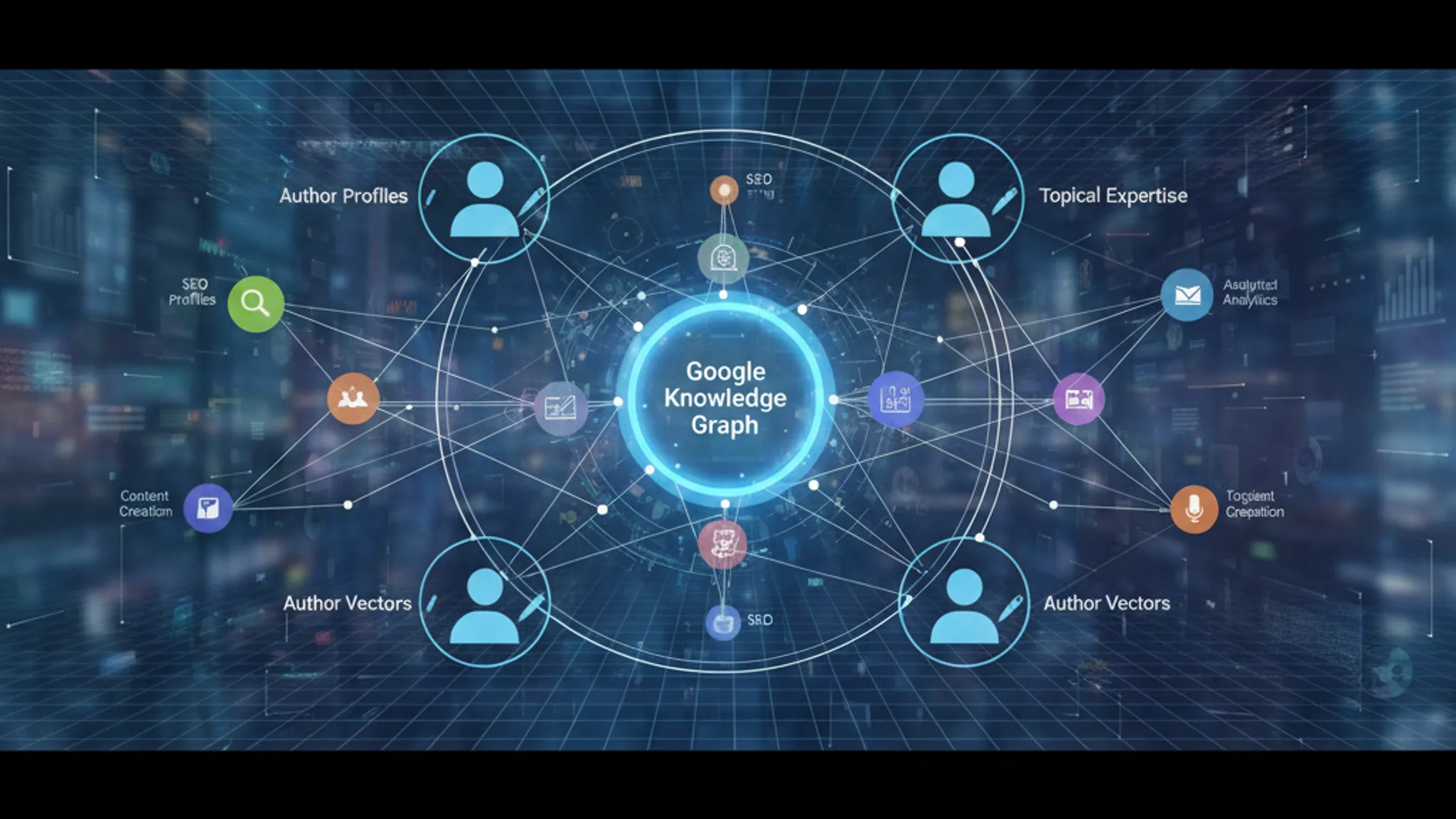
Author entities exist within Google's larger entity system. Just as Google maintains entities for companies (Amazon, Apple), places (New York City, London), and topics (artificial intelligence, renewable energy), it maintains author entities for individual creators. These entities are stored in Google's Knowledge Graph, which currently contains over 500 million entities with their associated relationships and attributes.
Here's what makes author entities different from other SEO signals: they travel with you. If you publish on one domain, then move to another domain, Google can recognize that you're the same author. The author entity you've built connects across those properties. This is fundamentally different from domain authority, which remains tied to a specific domain regardless of who publishes there.
Google builds author entities through several recognition methods. The primary method is consistent byline attribution across publications. When Google sees "Written by John Smith" across multiple articles on different domains, it begins to recognize John Smith as an author entity. The second method is structured data markup. When you implement Author schema in your article markup, you explicitly tell Google who authored the content. The third method is Named Entity Recognition (NER), where Google's natural language processing identifies author mentions in article text, author bios, and author archives.
Why does this matter for your SEO? Because Google's ranking algorithm considers author entity authority as a standalone ranking factor. Content from a recognized author entity with demonstrated expertise ranks higher than identical content from an unrecognized author. The stronger your author entity, the better your content performs.
E-E-A-T and Author Evaluation
E-E-A-T is Google's foundational content evaluation framework. The acronym stands for Experience, Expertise, Authoritativeness, and Trustworthiness. And while many SEO practitioners focus on domain-level E-E-A-T signals, Google increasingly evaluates E-E-A-T at the author level.
Experience refers to the author's direct, practical involvement with the topic. If you're writing about investment strategy, Google wants to know if you've actually invested money and managed portfolios. If you're writing about weight loss, Google evaluates whether you have personal experience with the specific methods you're recommending. Author entity evaluation includes measuring whether the author has documented experience through their publishing history.
Expertise refers to the author's demonstrated knowledge and skill in a specific domain. This is where author entities become particularly important. Google evaluates author expertise by analyzing the breadth and depth of content the author has published on a topic. If you've published 47 articles about Python programming, Google recognizes you have Python programming expertise. That expertise strengthens your author entity and increases the ranking potential for future Python-related articles you write.
Authoritativeness is about recognition and reputation. Here's where author entities directly connect to ranking power. An authoritative author is one who has been cited, referenced, and recommended by other authoritative sources. Google's Knowledge Graph includes relationships that show which other authoritative figures in a field reference or cite specific authors. These citation patterns strengthen your author entity and signal your domain authority to Google.
Trustworthiness is about whether readers and Google can trust the information you provide. Author entities include trustworthiness signals like your publishing consistency, factual accuracy rates, and whether your content has been fact-checked or validated by third parties. Google's content quality evaluation includes measuring whether other high-authority sources vouch for your credibility.
Here's the critical insight that separates author entity strategy from generic SEO: Google's ranking algorithm evaluates these E-E-A-T signals at the author level independently from the domain level. This means you can publish on a newer domain and rank well if your author entity is strong. Conversely, you can publish on a high-authority domain and underperform if your author entity is weak or nonexistent.
The 2024 Google algorithm leak confirmed that Google's Helpful Content System explicitly evaluates what it calls "author_authority_score" as a distinct signal separate from domain authority. This score is calculated based on author entity recognition, publishing history consistency, topical focus, and citation patterns across the web.
The Google Knowledge Graph Connection
Google's Knowledge Graph is fundamental to how author entities work. The Knowledge Graph doesn't just store information about places, companies, and topics. It also maintains detailed profiles for author entities.
When Google indexes your content, it doesn't just add the text to its search index. It also updates your author entity profile in the Knowledge Graph. This profile includes metadata about you: your name, your topical expertise areas, the domains where you publish, your social profiles, your published content, your publication frequency, and your topical authority scores across different domains.
Author entity profiles in the Knowledge Graph contain relationships. Google records which topics you write about, which other authors you collaborate with, which domains host your content, and which authoritative sources cite your work. These relationships create a web of connections that define your author entity within Google's knowledge base.
Entity linking is how Google connects author mentions to author entities. When Google's NER system identifies an author mention in text (such as "Written by Sarah Chen" or "By Sarah Chen"), it uses entity linking to connect that mention to the specific author entity profile in the Knowledge Graph. This process includes disambiguation, ensuring that mentions of "John Smith" in different contexts refer to the correct John Smith author entity.
One of the most powerful aspects of Knowledge Graph author entity profiles is cross-publication recognition. If you publish on Medium, LinkedIn, your personal blog, and a major publisher's website, Google's entity linking can recognize that all of these publications are authored by you. This consolidation of publishing history strengthens your single author entity, making you a more authoritative presence in Google's Knowledge Graph regardless of which domain your content appears on.
Author Rank Patent and Author Signals
Understanding how Google evaluates author entities requires understanding the Author Rank patent. Filed in 2013 and granted in 2014, Google's Author Rank patent (U.S. Patent 8,694,511) describes the technical methodology for evaluating authors as ranking factors.
The patent describes author vectors, which are mathematical representations of authors within a multi-dimensional vector space. In this system, authors are represented not as simple scores but as vectors that capture their topical expertise, their publishing patterns, their citation patterns, and their relationship to other authoritative figures in their field. Two authors in similar expertise domains would have vectors pointing in similar directions, while authors in completely different domains would have vector directions far apart.
The Author Rank patent explains how Google measures author authority through several mechanisms. The first is content quality analysis. Google evaluates the quality of content an author has published over time, looking at signals like click-through rates, time on page, bounce rates, and whether readers find the content valuable. Authors who consistently produce high-quality content that readers engage with have stronger author vectors.
The second mechanism is citation analysis. The patent describes analyzing how frequently other authoritative sources cite or reference an author. If published research papers, news articles, or other authoritative online content reference you, that strengthens your author vector. Google effectively treats author citations similarly to how it treats page citations through backlinks.
The third mechanism is collaborative filtering. The patent describes recognizing that authors who collaborate with other authoritative authors, or whose work is frequently cited by authoritative authors, inherit some of that authority. Your author vector strengthens through association with other strong author vectors.
The fourth mechanism is topical clustering. Google identifies which topics you have published about and how deeply you've covered those topics. The more comprehensive your coverage of a topic, with consistent publishing over time, the stronger your author vector becomes for that specific topic. You might have a strong author vector for "machine learning" but a weak author vector for "classical music," depending on your publishing history.
The practical implication is that author signals are not a single score but a multi-dimensional evaluation of who you are as a creator. Google doesn't just ask "Is this author authoritative?" It asks "Is this author authoritative in this specific topic? How consistent is their expertise? How frequently do they publish? Are they cited by other experts? Do readers engage with their content?"
Implementing Author Schema Markup
Understanding how Google evaluates author entities is the theory. Implementing Author schema markup is how you put that theory into practice.
Author schema is structured data markup that explicitly tells Google who authored a piece of content. When you include Author schema in your article's HTML, you provide Google with a direct statement of authorship (eliminating ambiguity that might arise from byline text alone), the author's name which Google matches against known author entities in the Knowledge Graph, a link to the author's profile page or entity profile on your domain which helps consolidate author entity signals, and additional author metadata like the author's image, job title, or social profile URLs.
Your visible byline should be consistent across articles. If you publish as "Michael McDougald" in one article and "M. McDougald" in another, you're creating disambiguation problems for Google's NER system. Consistency is critical. Additionally, your byline should link to a dedicated author profile page on your domain. This page serves multiple purposes: it consolidates all articles by that author, it provides biographical information that strengthens the author entity, and it creates internal linking signals that amplify author authority.
Your author bio matters more than many creators realize. Your author bio should include your topical expertise areas (using relevant keywords naturally), your credentials and experience, your social profile links (which help Google connect your author entity across platforms), and a professional image (which helps with visual entity recognition). Google's knowledge evaluation guidelines explicitly mention that reviewers check author profiles to assess authoritativeness.
Building Author Entity Authority
Understanding how Google evaluates author entities leads to the strategic question: How do you build authority as an author entity?
The first requirement is consistency. An author entity only strengthens if it demonstrates consistent topical focus. If you publish about cryptocurrency one week, fitness the next week, and fashion the week after that, Google struggles to establish a coherent author entity. Instead, your author vector remains weak and diffuse. Strategic authors focus their content on specific topic clusters, publishing depth rather than breadth. This isn't about writing only about one topic forever. It's about thematic clustering where related topics naturally group together.
The second requirement is publishing frequency. Google's algorithm treats publishing frequency as a signal of authority. An author who publishes five high-quality articles about their expertise area every month is signaling stronger authority than an author who publishes one article every six months, even if both articles are equally high-quality. Consistency and frequency build author vector strength over time.
The third requirement is cross-publication presence. Your author entity strengthens when your publishing presence extends across multiple authoritative publications. If you publish on your personal blog and on Medium, LinkedIn, and industry publications, Google's entity linking recognizes this presence and strengthens your author entity. The consolidation of your publishing history across these platforms amplifies your overall author authority.
The fourth requirement is citation and reference. Actively seek opportunities for authoritative sources to cite and reference your work. This might mean writing original research that other sites naturally cite, publishing commentary that industry leaders share and reference, or developing ideas that become influential within your field.
The fifth requirement is direct author branding. Some authors optimize at the domain level (the site becomes famous) while others optimize at the author level (the author becomes famous). Top-performing content creators typically do both simultaneously, building both site authority and author authority. This means prominent author bio sections, author photos on every article, and dedicated author profile pages that help Google consolidate author entity signals.
Author Entities and Future Rankings
How Google evaluates author entities continues to evolve. The 2024 Google algorithm leak, which exposed internal Search API documentation, revealed important information about the future of author entity evaluation.
The Helpful Content System, which Google introduced in 2023 and refined throughout 2024, explicitly includes author entity evaluation as a component. Google's internal scoring includes metrics like "author_hops" (how many entities between the author and high-authority sources), "author_consistency" (whether the author consistently publishes about claimed expertise areas), and "author_citation_strength" (how frequently other authoritative sources cite the author).
The integration between author entities and other ranking systems suggests that Google is moving toward treating authors as distinct, valuable entities similar to how it treats domains as distinct entities. This shift has implications for how SEO professionals should approach content strategy. Individual creator authority is becoming as important as site authority.
The rise of AI-generated content is likely driving this shift. When Google cannot reliably distinguish AI-generated content from human-generated content based solely on textual analysis, author entity information becomes increasingly valuable. Content from recognized, authoritative author entities with strong track records of quality is likely to receive preferential treatment compared to content of uncertain or unknown authorship.
For content creators, the strategic implication is clear: invest in your author entity. Build consistent topical authority. Publish regularly. Seek citations from authoritative sources. Maintain consistent bylines. Implement author schema. Create a dedicated author profile page. The author entity evaluation component of Google's ranking algorithm is only going to become more important.
The creators who adapt to this shift and build strong author entities will find that their content ranks better, travels better across domains, and maintains authority even as they change publishing platforms. The creators who ignore author entity signals will find themselves competing solely on domain authority metrics, which is an increasingly challenging strategy as the web becomes more fragmented and more creators build presence across multiple platforms.
Your author entity is your most portable SEO asset. It travels with you. It strengthens with consistent effort. And increasingly, it's what Google uses to evaluate whether your content deserves to rank.
Michael McDougald
Founder of Right Thing SEO, a math-driven SEO agency based in Nashville and Sarasota. Michael has spent 15+ years helping businesses achieve sustainable organic growth through data-driven strategies.
Learn more about Michael →