
How Google NLP Models Parse Your Content from BERT to MUM
Most SEO advice still treats Google like a keyword counter. You pick a phrase, you sprinkle it around the page, and you wait for the search engine to reward you. That model died years ago, and I have watched it die in client crawl data more than once. The pages that win in search now are the ones Google can actually read, one sentence at a time, one entity at a time. That reading happens inside a stack of natural language processing models, and if you do not understand how they parse your content, you are optimizing blind.
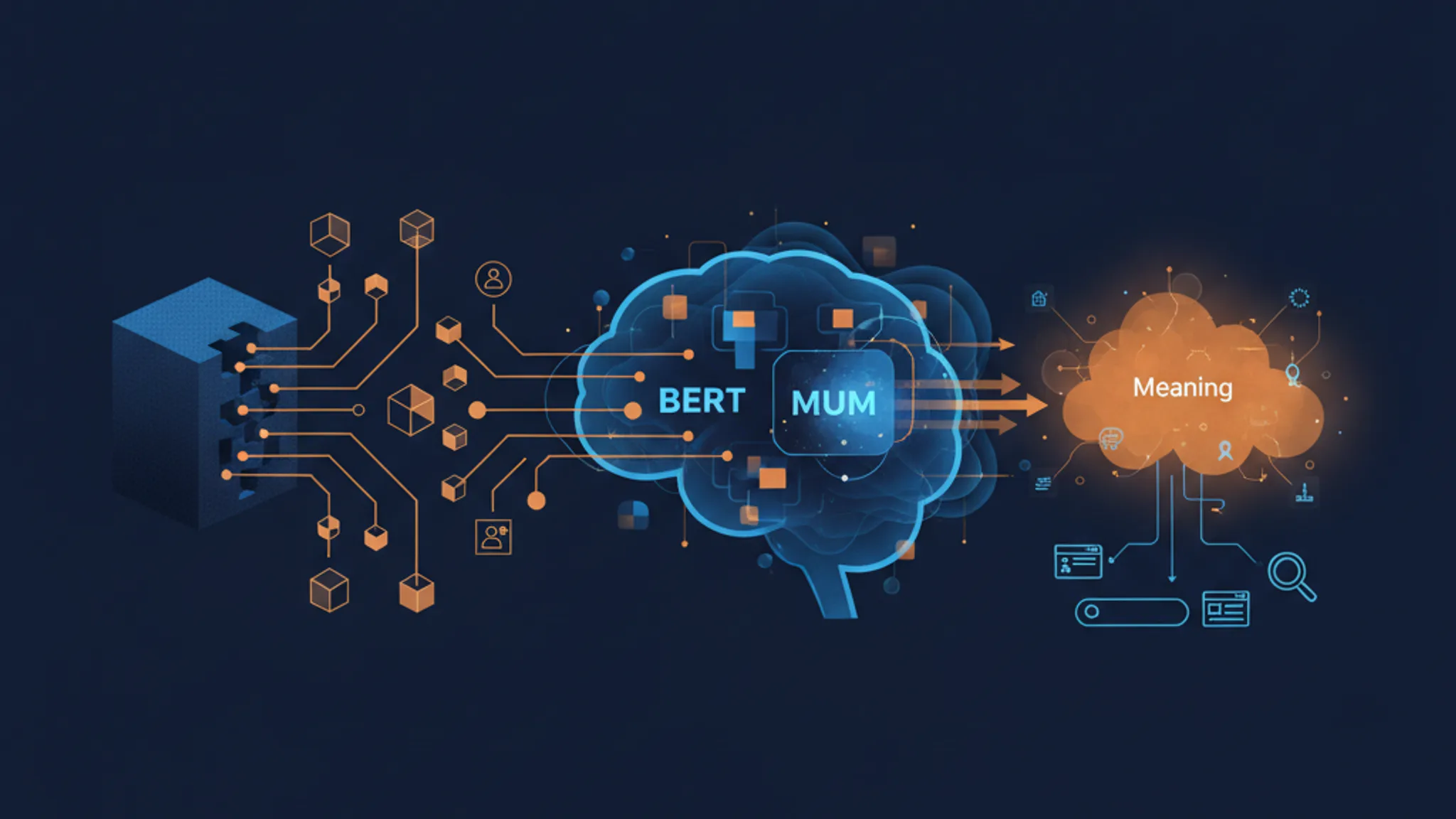
What Google NLP actually is, from BERT to MUM
Google NLP is the set of natural language processing models Google uses to turn your raw text into structured meaning. It tokenizes each sentence, tags parts of speech, maps the dependencies between words, extracts named entities, and scores how strongly your content is about a topic. BERT and MUM are the two best known of these models, and both run on the transformer architecture that lets Google read a word in the full context of every other word around it.
That context is the whole game. Before 2019, the search engine read your content more or less left to right, one word at a time, and it lost the thread on anything complicated. When Google rolled out BERT, the search team said it improved how it understood one in ten English search queries in the US. One in ten queries is not a tweak. That is a structural change in how the machine reads language, and it quietly rewrote what good content looks like. The keyword density worksheets most agencies still email around are optimizing for a version of search that stopped existing.
How Google NLP breaks your content into tokens, entities, and meaning
When the search engine parses a page, it runs an NLP pipeline any computational linguist would recognize. Search Engine Land documented the core components, and they line up with what the public Google NLP tool will show you if you paste your own text into it. The page gets tokenized into individual terms. Each word receives a part of speech. Lemmatization normalizes "cars" and "car" to the same root so the NLP model treats them as one thing. Dependency parsing draws the grammar links between words, and salience scoring measures how strongly the whole text connects to a given topic.
Named entity recognition is the step most SEOs underrate. Google reads your text, pulls out the people, places, products, and concepts it already knows, and works out how those entities relate to one another, because it cannot understand your page without first understanding its entities. Nouns become candidate entities, verbs describe the relationships between them, and the model assigns each entity to a type. This is how the search engine moves from a bag of words to a web of meaning. I covered the math underneath this in an earlier post on why embeddings are not magic, and the short version is that every token becomes a vector of numbers, and meaning lives in the distance between those vectors.
How the language model reads a sentence
The engine doing this work is the transformer. Google holds the attention mechanism patent, and the research paper that introduced it is the foundation for nearly every language model that followed, BERT and MUM included. When I explain this to clients, I tell them the parser is genuinely smart but stubbornly literal. The NLP model is doing real linguistic work on your sentences, scoring the relationships between your words to understand them, and clumsy writing throws it off the same way a missing comma throws off a human reader. The model does not forgive sloppy structure. It just scores your content lower and moves on.
From BERT to MUM, the NLP language models that read your search queries
BERT and MUM are not the same tool, and the difference shapes how you should write. BERT, which stands for Bidirectional Encoder Representations from Transformers, reads a search query in both directions at once so it can catch the meaning of small words like "to," "for," and "no" that flip a sentence completely. Google called it the biggest leap in search understanding in years, and it works on ranking and featured snippets, not only on query interpretation. The point of BERT was to kill "keyword-ese," the broken robot phrasing people used to type into search because they did not trust the engine to understand a real question.
MUM came next, and Google was loud about the jump. When the company introduced MUM, it described the model as a thousand times more powerful than BERT, trained across 75 languages at once, and multimodal, meaning it reads text, images, and video together. I put the difference to clients in one line. BERT taught the search engine to read a sentence. MUM taught it to read a topic, across formats and languages, in a single pass. Both are NLP models, and both exist to understand what the user actually wants.
Neural matching and the shift to user intent
Sitting alongside these models is neural matching, Google's system for connecting vague search queries to the right page even when none of the words match. neural matching and BERT, and her framing is one I repeat to every client. The search engine is no longer matching strings of text. It is matching user intent. When a user searches "places to chill on a sunny day," neural matching understands the user wants a park or a beach, not a weather report. It is reading the search intent behind the query, not the literal text the user typed.
The real work happens in query interpretation. The NLP stack identifies the entities in a search query, works out the semantic meaning of the words around them, settles on the search intent, and only then chooses which content to rank. The individual words of a query no longer stand alone. They are read in context, as a question with meaning, which is exactly how a person understands language. Your content has to answer the question the user actually meant, not the literal keywords typed into the search box. That is what natural language processing bought Google, and it is what most keyword-first SEO still ignores.
Google runs natural language processing on both sides of a search. On the query side, the language model parses what the user typed and extracts the intent and entities behind the words. On the content side, the same NLP models parse your page, score its entities, and decide what your text means. Ranking is the search engine matching the meaning of the query to the meaning of the content. When those two readings line up, you rank. When your content is vague and the model cannot understand it, you do not, no matter how many times the keywords appear. This is why understanding how the parser reads language is worth more than any keyword tool. Two search queries that look almost identical can carry different user intent, and the NLP model is built to tell them apart by reading the semantic relationships between the words rather than the words alone.
When your content is vague and the model cannot understand it, you do not, no matter how many times the keywords appear.
Why Google NLP rewards entities and semantic search over keyword SEO
Here is where I lose patience with the industry. People still chase "LSI keywords" as if Google ran a 1980s library index. It does not. John Mueller has said so directly, and the whole idea of latent semantic indexing as an SEO tactic is a myth that refuses to die. The search engine does semantic search through entities and embeddings, not through a list of related keywords you stuff into a paragraph and call optimization.
What Google NLP actually rewards is aboutness. Salience, in the linguistic sense, measures how strongly your text connects to a topic, and the model builds it from the co-citation of entities across the web and inside knowledge bases like Wikipedia. Some of those entities live in the Knowledge Graph as well-defined things, and many more are lower-case entities that Google recognizes from your content without giving each entity a knowledge panel. When your content names the right entities and places them in clear relationships, Google's confidence that your page is about that topic climbs. I broke down how this feeds the Knowledge Graph in my piece on how Google clusters entities into a knowledge panel, and the same NLP mechanism decides whether your content reads as authoritative or thin.
This is the shift from strings to things, and it is why an article packed with the exact keyword can still lose in search to one that never repeats it but covers the entities completely. The search engine reads for meaning. Your keyword is a hint, not the answer, and treating the keyword as the answer is how thin content gets written and why so much of it never ranks.
How to use Google NLP signals to write SEO content search engines can parse
The practical work is less exotic than it sounds. Years ago Justin Briggs published the clearest guide I have read on writing on-page content for NLP, and his rules still hold up. The goal is to make your sentences easy for the parser to follow so the NLP model can lift a clean answer straight off the page and understand exactly what you mean.
Answer the user's question in one clear sentence
When you answer a question, reconstruct it into a plain statement where the entity is the answer. "The safe internal temperature for cooked chicken is 165 degrees Fahrenheit" gives Google a short path from subject to number. A rambling sentence with ten grammatical hops between the noun and the answer forces the parser to work harder, and its confidence drops. I have audited pages that sat on page two with correct, expert answers buried inside complex prose, while a featured snippet went to a thinner competitor who simply wrote the answer in one clean line. The expert lost the search result to the better sentence. That is NLP picking the clearer text, not the more knowledgeable author.
On one manufacturing client, the fix was almost embarrassing. Their engineers knew their subject cold, but every spec answer was wrapped in three clauses of context before it reached the number a user was searching for. We did not add information. We rewrote the sentences so the answer came first and the entity sat next to it, and within a few weeks the pages started winning the featured snippets they had been losing. The content did not get smarter. It got readable to the NLP model, which is a different thing, and the search traffic followed.
Use indicator words to disambiguate your entities
Watch your pronouns. When you write "they" or "it" and the noun it points to sits two sentences back, the model can lose a connection a human reader would make without thinking. Disambiguate your entities, especially when a name could mean two things, by adding the indicator words that tell Google which Portland or which Mercury you mean. These indicator words also raise the salience of your topic, which is why subject matter experts who use the real vocabulary of a field tend to rank in search without trying. They are feeding the language model the terms and entities it expects to see around that topic, and that vocabulary is a stronger relevance signal than any keyword you repeat on purpose.
Use structure to carry meaning into the content
Structure is not decoration. Headings, lists, and proximity all carry meaning to the parser. A numbered list reads as a ranking or a process. A heading defines everything beneath it until the next heading. Keep related information close together, because words in the same sentence read as closely related and words three sections apart read as barely related at all. This is technical SEO for content understanding, and it is exactly the work we do in a technical SEO audit. It also sits at the center of the Nashville SEO playbook we build every strategy on. Write so the NLP model can read you, and the search rankings tend to follow.
What Google NLP means for SEO and search intent from here
The systems are only getting more capable, and the direction is not subtle. AI Overviews and retrieval-augmented generation pull answers straight from content the NLP stack has already parsed, scored, and ranked. The better Google's understanding of language gets, the more it rewards content written for meaning instead of for keyword density. Passage-level retrieval sharpens this further, because focused single-topic chunks, which is the same lesson Briggs was teaching about clear sentences, scaled up to whole sections. The way the search engine judges an entire domain runs on related language models too, which I covered in the helpful content classifier.
None of this changes the core job. Every advance in natural language processing, from neural matching to BERT to MUM, pushes Google toward the same goal: understanding search queries and content well enough to match the user to the right answer. The semantic understanding keeps getting deeper, the entities keep getting richer, and the relationships the model can read keep getting subtler. For SEO, that means the safest bet is the boring one. Write content that says something real, name the entities and information a reader on that topic needs, and structure the text so the NLP model can understand it on the first read. Optimize for the meaning, and the keywords take care of themselves.
Search intent runs through all of it. When Google can understand the intent behind a query and your content answers it, you rank, and when the model cannot understand your text, you do not. The NLP models read the semantic relationships in your content, the entities you name, and the information each one carries more accurately every year. Natural language is the interface now, and the SEO that respects how the model reads language will keep working while the SEO that fights it falls behind.
So stop writing for a keyword counter that retired a decade ago. Write for the NLP parser that is actually reading you. Name your entities, answer your questions in clean sentences, and structure your page so Google NLP can extract the meaning from your content without guessing. That is the discipline that survives every model from BERT to MUM, and whatever search ships next.
By Michael McDougald
Michael McDougald
Founder of Right Thing SEO, a math-driven SEO agency based in Nashville and Sarasota. Michael has spent 15+ years helping businesses achieve sustainable organic growth through data-driven strategies.
Learn more about Michael →