How Google's AI Actually Measures Trust & Expertise (And What You Can Do About It)
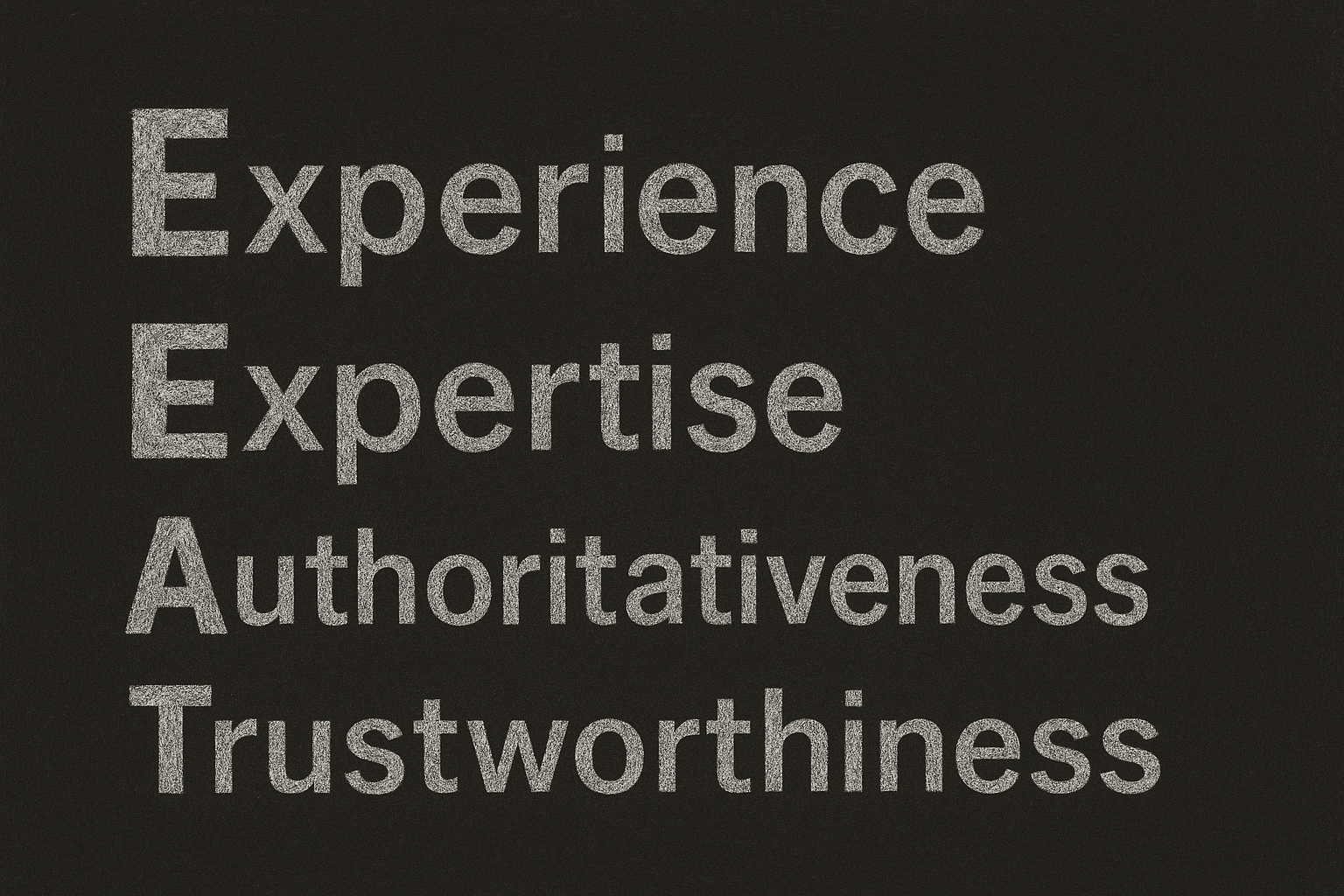
If you're like most SEO professionals, you've heard endless chatter about Google's mysterious E-E-A-T – the acronym for Experience, Expertise, Authoritativeness, Trustworthiness – and how it supposedly impacts rankings. Is E-E-A-T really Google's "secret sauce," or just a buzzword? The truth is a bit of both. Google doesn't assign pages a literal "E-E-A-T score" – in fact, the term "E-E-A-T" is never explicitly mentioned in any Google patent, leaked API documentation, or DOJ court evidence. Instead, E-E-A-T is more like a guiding principle reflected through dozens of indirect signals and AI-driven subsystems. Recent insights from leaked Google documents and a 2023 antitrust trial have pulled back the curtain on many of these systems, revealing how Google likely evaluates trust and expertise using machine learning (ML) models and large language models (LLMs).
In this in-depth report, we'll explore how Google's AI actually measures a site's credibility and content quality – and what you can do to align your SEO strategy. We'll look at Google's "layered" ranking pipeline that uses a path-of-least-resistance approach (think simple algorithms first, advanced AI later). We'll dig into user behavior signals like NavBoost that leverage 13 months of click data to boost satisfying results. We'll examine how links serve as trust proxies (hint: it's about quality, not quantity – including how close you are to trusted "seed" sites). We'll break down site-level vs. page-level factors, and introduce a useful framework ("STuDCo") to categorize ranking signals by Search intent, Trust, User signals, Document content, and Context. Finally, we'll discuss topical expertise – how Google may detect if you have true depth in a subject via content clusters – and the role of freshness and information gain (novel content) as separate ranking influences. Throughout, we'll keep a practical focus: helping you understand Google's ranking design so you can take action. Let's jump in.
E-E-A-T: A Principle Reflected in Signals, Not a Direct Score
First, let's clarify what E-E-A-T is and isn't. E-E-A-T stands for Experience, Expertise, Authoritativeness, and Trustworthiness, an expanded concept in Google's search quality rater guidelines (the extra "E" for Experience was added in late 2022). These are criteria human quality raters use when evaluating search results quality, especially for "Your Money or Your Life" topics. However, Google's own spokespeople have confirmed that E-E-A-T is not a discrete ranking factor or numeric score in the live algorithm. There is no internal "E-E-A-T algorithm" that assigns your page a 1-100 score for trust or expertise. Instead, Google uses a mix of signals to approximate these qualities indirectly. As Google's John Mueller put it, E-A-T is primarily a concept to help quality raters provide feedback on search results – not something like PageRank that's computed directly.
That said, as an SEO, you ignore E-E-A-T at your peril. Google absolutely cares about the trustworthiness and expertise behind content – it just measures them through other means. Think of E-E-A-T as the outcome Google wants (high-quality, trustworthy results), achieved via many algorithms under the hood. For example, Google's systems will analyze what a page says and how it says it to gauge expertise, check who is behind the site and who is referring to it (links) to gauge authoritativeness, and monitor how users interact with it to gauge trust and usefulness. Importantly, all evidence from patents, leaks, and court docs suggests Google doesn't hard-code an "E-E-A-T variable" – instead, it relies on myriad proxy signals and ML models to evaluate those qualities.
Key takeaway: Don't expect to find a magical "E-E-A-T tag" or one metric to optimize. E-E-A-T lives in the combination of many factors – content relevance, factual accuracy, backlinks, user engagement, brand reputation, and more – which we'll explore next. In short, Google evaluates trust and expertise holistically. Now, let's see how Google's ranking pipeline is structured to incorporate these factors efficiently.
The Layered Ranking Pipeline: Google's "Path of Least Resistance" Approach
One of the most important insights from recent revelations is that Google's ranking process is multi-stage and layered. Rather than throwing the most expensive AI models at every webpage, Google follows a "path of least resistance" – it uses the simplest, most cost-efficient methods to narrow down candidates, then applies more advanced algorithms on the refined set. This strategy appears over and over in Google's system design.
Initial retrieval (lexical scoring): When a query is submitted, Google's first task is to find a pool of potentially relevant documents from its index. This is typically done using classic information retrieval techniques like term frequency–inverse document frequency (TF-IDF) or its successor BM25 (Okapi BM25), which rank documents by keyword matches. Google's index (often called the "Word Index") can very quickly pull up, say, a few thousand documents that contain the query terms or their synonyms. According to one analysis of Google's search system design, a component called Ascorer selects the Top 1000 URLs for a query – this set is sometimes referred to as the "Green Ring" of results. These initial scores may incorporate simple factors like keyword frequency, basic PageRank, and localization, but they're largely lightweight calculations. By doing this first cut with fast, scalable algorithms, Google avoids burdening its system with billions of pages unnecessarily.
Semantic reranking (neural models on top results): Once Google has ~1000 candidates that lexically match the query, it moves to the next layer: more sophisticated semantic analysis. This is where large ML models like BERT (Bidirectional Encoder Representations from Transformers) or other transformer-based rankers come into play. It's computationally expensive to run a BERT-style model across an entire index, but running it on a thousand results is feasible. Google uses these neural models to better understand the meaning of the query and content, re-scoring the candidates based on semantic relevance and context. In effect, BERT (or similar) acts as a re-ranker, refining the initial list into the final Top 10 (the first page results). An internal Google ranking architecture described in leaked documents mentions a component called Superroot that is responsible for whittling down the Green Ring (~1000 results) to the "Blue Ring" (the top 10 results). Superroot doesn't do this alone – it orchestrates a host of specialized re-ranking algorithms (more on those soon) – but fundamentally it's the second-stage precision work after the first-stage recall.
This two-stage approach (first keywords, then vectors/transformers) epitomizes the "layered path of least resistance." Google uses cheap operations (BM25, etc.) to cast a wide net, then expensive operations (neural NLP models) on a small catch. The result is a highly efficient yet powerful ranking pipeline. Notably, this layered design isn't limited to retrieval – it recurs throughout Google's ranking systems. For example, Google's Pandu Nayak testified that ranking "happens in stages," with certain signals applied early and others later. We see this in how user behavior signals (like NavBoost) and personalization are applied at different ranking stages, or how cascades of classifiers might first filter out spammy sites to a sandbox before deeper content analysis is done.
In practical terms, SEOs should understand that different ranking factors "kick in" at different stages. First, you won't even be considered if you don't have basic relevance (keywords/context) and crawl/index friendliness. Then, to move up into the top results, your content better satisfy semantic intent and quality as judged by more advanced models. This also means optimizing for one stage doesn't guarantee final ranking – for instance, keyword stuffing might get you through the initial filter, but a BERT-based relevance model will later demote shallow, off-topic content. Similarly, a page might pass the content relevance checks but then get down-ranked by later-stage trust or user satisfaction signals.
Finally, it's worth mentioning internal code names alluded to in leaks: for example, an initial scoring service known as "Scorer" or "Ascorer", and a snippet-evaluation model called "Muppet". These likely handle some of the first-pass scoring and snippet generation before the final re-rank. We don't have to dive into those, but know that Google's pipeline is complex and segmented – with each segment doing the simplest job it can, then handing off to the next. By adopting this layered approach, Google makes its search both fast and smart – a key theme to remember as we delve into specific ranking signals.
User Behavior Signals and NavBoost: Measuring "Information Satisfaction"
Once Google has identified relevant pages for a query, how can it determine which ones are truly the best results? One powerful clue comes from user behavior – what real users click on and engage with. For years, Google downplayed using click signals (fearing manipulation), but Thanks to recent revelations from the Department of Justice's Google antitrust documents, we know Google explicitly uses NavBoost to override traditional ranking signals based on long-term user engagement.
What is NavBoost? It's essentially a user feedback loop in the ranking algorithm. NavBoost monitors how users interact with search results (primarily the classic "blue link" results) over time, and feeds that information back into future rankings. According to Google's Pandu Nayak, NavBoost has been an important part of Google's ranking since as early as 2005. In the 2023 trial, he confirmed "Navboost is one of the important signals that we have" for rankings. More recently, internal documents from other trials detailed by Search Engine World reveal that Google's RankEmbed system integrates directly with NavBoost, embedding user engagement signals into the AI-driven ranking decisions."
How NavBoost works: Google stores about 13 months of user interaction data – more than a full year – and uses it to evaluate how well each result for a given query satisfied users. In practice, when searchers see a result and click it (or ignore it), and how they behave after clicking, are aggregated into metrics. Leaked Google API documentation suggests NavBoost tracks things like: total impressions (times a result was shown), clicks, good clicks vs. bad clicks, lastLongestClick, etc. A "good click" likely means the user clicked and stayed on the page (positive engagement), whereas a "bad click" could mean the user quickly bounced back to the search (a sign the result wasn't helpful). The "lastLongestClick" appears to indicate when a user clicked a result and never came back – presumably because it fully satisfied their query. These are strong indicators of success. Essentially, NavBoost is computing an "information satisfaction" score for each page-query pair over time – did this page successfully answer the user's need?
Importantly, NavBoost doesn't treat all user behavior uniformly. It "slices" the data by context like the user's location and device type. That means Google recognizes that, say, a result that satisfies users in one country might not perform as well in another, or that mobile vs desktop usage can differ. NavBoost creates separate data segments ("slices") for these scenarios. For example, if people searching for "Pizza Palace" on mobile in New York consistently click the second result more than the first, NavBoost will take note in that locale and on mobile. Over time, it might boost that second result higher for mobile users in NYC because it's proven to be the preferred (most satisfying) result in that contex. Google essentially lets users vote with their clicks and dwell time, and NavBoost uses those votes to reshuffle rankings where appropriate.
One concrete way NavBoost might manifest: consider a new page that Google initially ranks in position #2 for a query. Historically, the second position might expect around a 15% click-through rate (CTR) on average. If users love this new page and its CTR is, say, 25% (far above the norm), NavBoost will interpret that as a positive signal and potentially promote the page to #1. Conversely, if that page in #2 only gets 5% CTR (way below expected), it suggests searchers don't find it appealing; NavBoost could demote it further down. In effect, Google is testing results and letting user behavior correct the ranking over time. This aligns with what was reported from trial documents: Google tracks the expected CTR by position and notices when a result underperforms or over performs – then adjusts rankings accordingly as a form of result quality control.
It's worth noting that Google long denied "using CTR as a ranking factor." In public, Googlers (like Gary Illyes and others) called such metrics "made up crap" in years past. But those denials were carefully worded – Google likely didn't want webmasters aggressively gaming clicks. The reality, as the evidence now shows, is that Google does use click and engagement data in aggregate, in systems like NavBoost. It's just not a simple one-to-one ranking factor; it's part of a complex, anonymized, long-term feedback system. Also, NavBoost appears to focus more on navigational or highly relevant queries – cases where user preference is a strong indicator of result quality. (The name "NavBoost" itself comes from "navigation" – originally it might have been intended to boost navigational results that users clearly favor, like an official homepage.) Today, however, its use seems broader, refining results even on informational queries by learning which pages users find most helpful.
For SEO practitioners, the implications are clear: user engagement matters for SEO. To optimize for NavBoost, you should aim to attract clicks (through compelling titles/snippets) and satisfy users so they don't pogo-stick back to Google. High click-through combined with low bounce-back (and ideally long dwell time) sends glowing signals to Google's systems. On the flip side, clickbait titles that lead to disappointed users will backfire – you might get the click, but if users immediately leave (a bad click), that could harm your rankings over time. In short, Google is crowdsourcing quality control: if the crowd consistently loves your result, you'll likely get a boost; if they hate it, expect a demotion.
One more system to mention in the user-behavior realm is "Glue." Glue is like NavBoost's sibling, but instead of focusing on the blue-link web results, Glue looks at interactions with SERP features – things like the news carousel, video carousels, "People Also Ask" boxes, AI snapshots, etc. Glue monitors how users engage with those richer features (do they scroll a carousel? click "expand" on an AI answer? ignore a certain widget entirely?). Google uses that to decide which SERP features to show and where. For example, if users always swipe through the "Top Stories" carousel for a certain type of query, Glue will ensure that carousel appears prominently for similar queries. If a fancy new SERP feature gets no engagement, Google may quietly drop it on those results. Glue works alongside NavBoost to continuously tune the search experience based on what real people respond to.
Takeaway: Google's AI doesn't just analyze static page content; it also learns from user behavior. As AJ Kohn eloquently captured on his site Blind Five Year Old, Pandu Nayak's insights make clear that SEO must align not with rigid rules, but with Google's flexible, intent-based evaluation system.The NavBoost system leverages over a year's worth of interaction data to measure which pages truly satisfy ("information satisfaction") and uses that as a ranking signal. While you can't control users, you can influence these signals by making your search snippets enticing and your content genuinely useful and engaging. In the battle for trust and relevance, the voice of the user is ultimately the loudest – Google has built systems to hear it.
Relevance, Pertinence & Quality: The Condensed "STuDCo" Framework
To clearly understand Google's ranking process, think of three core dimensions: relevance, pertinence, and quality, which align well with the STuDCo framework (Search, Trust, User, Document, Context). Here's a condensed breakdown of these factors:
Search (S): Relevance to Query Intent
Search covers Google's understanding of the query and finding matching content. Classic algorithms like BM25 and neural models like BERT ensure the result aligns linguistically and semantically with the user's intent. To rank, your content must clearly match what users are searching for.
Trust (T): External Authority Signals
Trust encompasses external signals of credibility, primarily backlinks and reputation. Google's systems (like PageRank and possibly variants of TrustRank) evaluate who references your site and your site's distance from trusted "seed" domains. Additionally, Google's understanding of entities and their reputations can bolster perceived authority. Essentially, Trust ensures ranked pages are reliable and authoritative.
User (u): Engagement & Behavior
User signals include click-through rates, dwell time, and behaviors tracked by systems like NavBoost and Glue, measuring real user satisfaction. This dimension captures pertinence - is your content truly helpful to users? If searchers bounce quickly, rankings suffer. Google may further personalize results ("Twiddlers") based on past user interactions.
Document (D): On-page Quality & Expertise
Document signals focus on the actual page content - its depth, structure, readability, and accuracy. Google's Helpful Content System and NLP models or LLMs classify content to assess quality and expertise. Document-level quality ensures content is trustworthy, comprehensive, and relevant to queries.
Context (Co): Situational & Environmental Factors
Context covers location, language, device type, and freshness. Google adapts results based on these situational factors to ensure immediate pertinence - localizing results, handling ambiguous queries like "jaguar," and elevating fresh content for timely searches.
E-E-A-T Through the STuDCo Lens
Google doesn't explicitly measure "E-E-A-T," but its elements emerge through STuDCo signals:
- Experience & Expertise mostly through Document quality and Trust signals.
- Authoritativeness primarily via Trust (who cites or references you).
- Trustworthiness combines Trust and Document accuracy, also informed by User satisfaction.
Historically, SEO efforts prioritized "Search" and "Document" (relevance). Today, "Trust" and "User" factors critically differentiate similar relevant content. A page might perfectly match query intent, but without Trust signals (backlinks, reputation) or User engagement, it won't rank consistently.
Using STuDCo in Your SEO Strategy
STuDCo serves as a practical checklist for content optimization:
- Search: Does content linguistically and semantically match intent?
- Trust: Is content externally validated by credible backlinks?
- User: Does content engage users effectively (low bounce, high dwell)?
- Document: Is content high-quality, demonstrating genuine expertise?
- Context: Is content appropriately localized, fresh, and relevant for the user's situation?
Ranking high means balancing these factors. A strong brand (Trust) won't overcome thin content (Document), just as great content struggles without external authority signals. Ultimately, Google's ranking operates like a multi-variable equation:
Query + Context ➜ Relevant Content filtered by Quality & Trust validated by User Satisfaction
This ensures top results aren't merely keyword matches, but genuinely helpful and trustworthy resources.
Links as a Trust Signal (and Why Link Distance Matters)
Ever since Google's inception, backlinks have been the backbone of its authority measurement. PageRank – Google's original algorithm – treated links as "votes" for quality. Over the years, Google has refined link analysis to be more selective (fighting link spam, ignoring low-quality links), but backlinks remain a crucial trust signal in E-E-A-T context. In Google's own documentation, link analysis systems (including PageRank) are listed among core ranking systems still in use.
From an E-E-A-T perspective, authoritative backlinks are effectively endorsements of your expertise and trustworthiness. A medical article cited by Mayo Clinic or WebMD, or a finance blog referenced by the Wall Street Journal, is going to carry much more weight than one with no such votes. Links are external validation – they tell Google "others find this content valuable or credible." This is why link building (the right way) is still an important part of SEO for YMYL topics where trust is paramount.
However, it's not just the number of links – it's who they're from and how close your site sits to trusted sources in the web's link graph. Researchers and SEOs have long discussed the concept of "TrustRank," which describes how search engines might calculate a trust score by starting from a set of hand-picked seed sites that are deemed extremely trustworthy (e.g. major university sites, government sites, top news sites) and measuring how far any given page is from those seeds via links. A site that is directly linked by a seed (one click away) would inherit a lot of trust; a site two hops away slightly less; and if you're 10 hops away (only getting links from very untrusted corners of the web), your trust score would be low.
While Google has never publicly confirmed using 'TrustRank' explicitly, several original Google patents outline methods of evaluating link proximity to seed or authoritative sites, strongly supporting the idea that proximity-based trust weighting is actively employed.
The logic is intuitive: Spam sites tend to link in clusters and rarely get links from highly trusted domains, whereas authoritative sites eventually get "within earshot" of other authorities. In practice, Google likely uses a variant of this – not as a singular metric but woven into its ML models. For example, the algorithm might have features like "percentage of backlinks from high-trust domains" or "lowest DomainRank of any linking domain" as inputs to a page's quality score. Indeed, SEO toolmakers (Moz's MozTrust or Majestic's Trust Flow) created metrics inspired by this idea, calculating the link distance from trusted seed sites. This approach makes for a very logical link building strategy. And an analysis of a Google leak suggests that newer PageRank iterations incorporate trust, essentially weighting links by the reliability of their source.
Link graph distance is something to consider in your SEO strategy. Getting a link from a highly trusted site (say, a .gov or a major news outlet) is like drastically shortening your distance to the "authority hub" of the web, which can uplift your entire site's standing. On the other hand, a large quantity of links from dubious sources (link farms, low-quality directories) won't help and might even flag you as being in a bad neighborhood. In essence, one link from an "expert" site in your niche can outweigh 100 links from no-name blogs. It's quality, relevance, and proximity to trust that counts.
Beyond link analysis, Google's trust evaluation likely includes other off-page factors: mentions (even unlinked brand mentions could be noted by sentiment analysis or knowledge graph connections), historical performance (has this site been delivering trustworthy content for years, or did it appear yesterday?), and penalties/violations (sites with a history of violating guidelines might carry an algorithmic stigma). For example, Google's algorithms like Penguin (link spam filter) and manual actions ensure that if a site tries to fake trust with manipulative links, it backfires.
In the context of E-E-A-T, you should view links as a proxy for Authoritativeness and part of Trustworthiness. A strong link profile from relevant, authoritative sites is one of the best proxies for "peer recognition" of your expertise. It's no coincidence that many of the sites considered high E-E-A-T (think respected news sites, academic domains, well-known brands) have tons of authoritative backlinks. Even if Google had no idea who authored a piece, the link profile can imply "this site is taken seriously by others in the field."
One more angle on links: internal links and site architecture. While external links carry more weight for authority, your internal linking structure can help distribute whatever "authority" your site has to the pages that matter, and also signals which pages you consider most important (which often aligns with where your expertise lies). Also, internal links help Google understand the topical organization of your content – which plays into the next section on topical expertise.
In summary, links remain a foundational trust signal in Google's AI-driven ranking. Focus on earning links from authoritative, relevant sources – that not only boosts your PageRank but likely feeds Google's ML models that your site is an authority worth ranking. And remember the "company you keep" in the link graph: being cited by trusted sources puts you closer to the hub of credibility, whereas spammy link tactics can exile you to the fringe.
(Stay tuned: In future articles, I'll dive deeper into how Google might algorithmically evaluate link quality and incorporate the link graph in modern ranking, including concepts like seed-set distance and the evolution of PageRank. For now, the key point is that links = votes of trust, and not all votes are equal.)
Page-Level vs. Site-Level Signals: Content Analysis vs. Domain Reputation
Another critical aspect of E-E-A-T evaluation is understanding the difference between page-level signals and site-level signals, and how Google balances the two. Simply put:
- Page-level signals are those that apply to a specific page (URL). This includes the actual content of that page (its text, structure, keywords, etc.), on-page SEO elements, the author or schema markup on that page, and even user metrics specific to that page (like its CTR or bounce rate for a query). Page-level analysis answers, "Is this particular page high quality and relevant for the query?"
- Site-level signals apply to the domain or site overall. These include the site's backlink profile as a whole, its historical performance (Has the site produced a lot of high-quality content or a lot of spam? Has it been subject to major algorithmic demotions like the Helpful Content system?), brand recognition, and possibly aggregate user signals (e.g., does the site have a loyal following or consistently good engagement across pages?). Site-level analysis answers, "Is this website (and its authors) generally authoritative and trustworthy in this topic area?"
Google's official statements on the Search Central blog confirm they explicitly consider site-wide content quality and topical authority as part of their ranking systems. Google uses both in ranking, but importantly, site-wide signals can influence page rankings without the page itself having all the credentials. For instance, if The Lancet (a prestigious medical journal site) publishes a new article, that page starts with a hefty trust advantage even if it's brand new – because Google knows The Lancet site is top-tier in medical content. Conversely, if a site has a poor reputation overall, any new page on it might be algorithmically held back, even if that page's content is decent, because the site-level signal says "caution, this domain is low-quality."
Google has explicitly stated that site-wide classifiers are used as part of understanding pages. A prime example is the Helpful Content System (HCS). Announced in 2022, this ML system generates a site-wide signal that identifies if a site tends to have a lot of unhelpful, SEO-first content. Initially, HCS was described as a site-wide demotion – meaning if triggered, it could potentially depress rankings for all pages on the site until the content improves. (They have since nuanced it to say site-wide signals are used, but not an absolute penalty – great content on a "tainted" site can still rank, and vice versa.) This is a perfect illustration of page vs. site: you could have a particular page that is well-written, but if it lives on a domain Google's classifier deems largely unhelpful, that page might not rank as well as it otherwise could, due to the site-wide signal dragging it down. Moz's insightful breakdown on Google's Helpful Content update illustrates clearly how content quality signals are increasingly machine-classified, reinforcing Google's shift toward genuine user satisfaction.
On the flip side, site authority can rescue pages. Think of major news sites that might put out a mediocre article; thanks to their overall authority, the article might still rank above more detailed content on a lesser-known site. Google tries to mitigate blindly favoring big domains (they have algorithms like "Domain Diversity" and the Exact Match Domain adjustment to avoid one site dominating or low-quality EMDs gaming results). Yet, the reality is that who publishes can matter as much as what's published. That's the site-level influence.
Some site-level trust signals Google likely uses:
- Domain age and history: An older domain with a long track record (especially one that hasn't changed ownership or topic) can be seen as more stable and trustable. Frequent domain churn or a pattern of spam on the domain can hurt future trust.
- Knowledge Graph entities: If Google recognizes the site or its authors as entities with authority (e.g., a known financial advisor who has a Knowledge Panel, or a site that is an official organization), that can inform trust. Google may connect content to known entities via its Knowledge Graph, effectively saying "this site is run by Expert X, who is an authority in this field" – thus boosting E-E-A-T. This is speculative but in line with Google's direction of understanding real-world entities behind content.
- Site-level engagement: Do users generally interact well with this site's content? For example, direct traffic or brand searches (people specifically searching for "[Sitename] + topic") indicate a level of trust/authority with users. It's been theorized that Google might use such signals (possibly in a soft way, since they could correlate with quality).
- Technical and safety signals: A site with good technical hygiene (HTTPS, no malware, good Core Web Vitals, etc.) might get a slight site-wide trust uptick, whereas a site known for intrusive ads or frequent hacks could get downgraded. While these might not scream "E-E-A-T" traditionally, a secure, well-maintained site indirectly supports trustworthiness.
Now, how do page-level and site-level signals interact? Google's own documentation puts it nicely: having good site-wide signals doesn't guarantee every page ranks highly; having poor site signals doesn't doom every page either. They work in tandem. One way to imagine it: site-level trust might act as a multiplier or a threshold in ranking algorithms. A strong site can uplift its pages, but those pages still need to be relevant and reasonably good. A weak site can drag down its pages, but an exceptionally relevant/high-quality page might break through for certain queries despite the handicap.
Machine learning likely plays a role here: Google could feed a model various features about the page (content length, language complexity, sentiment, etc.) and features about the site (overall link authority, average content quality rating, etc.), and the model outputs a combined quality/relevance score. For instance, a page from "Site A" (high authority) with an 80% content score could outrank a page from "Site B" (low authority) with a 90% content score, because the model weighs site authority heavily. But if Site B's page is much, much better (say 99% vs 60%), it might win even though Site B is usually untrustworthy – perhaps an outlier of great content on that site.
For SEO, this dynamic means you must tend to your site's overall reputation, not just individual pages. You can optimize a single page perfectly, but if your domain is known for low-quality content or lacks any authority signals, that page might still struggle. Conversely, building a strong brand and authority can make all your content perform better. It's a reminder that SEO is both granular and holistic.
Actionable tips:
- Improve site-wide E-E-A-T cues: Include author bios on content to highlight expert credentials, have robust About and Contact pages, cite sources, and adhere to a consistent standard of quality across your site. Quality Rater Guidelines explicitly look at site info for E-E-A-T evaluation, and while raters don't directly affect rankings, the algorithm may seek similar signals.
- Clean up or remove junk content: If half your site is thin or low-quality content, it could be dragging down the other half. Marie Haynes discusses how the HCU has been updated as part of the core systems and that it creates a site wide classifier that can impact your site as a whole. Site-wide classifiers like the Helpful Content system consider the proportion of good vs. bad content. A smaller site with only excellent content can outrank a larger site that's a mixed bag.
- Leverage your domain strengths: If your site is authoritative in one niche, keep your content mostly within that niche. Venturing too far afield might dilute your site-level topical authority. Google's "topic authority" system for news (coming up next) underscores this principle – sites that specialize are rewarded within their topic domain.
- Be mindful of site-level penalties: Avoid tactics that could get your entire site flagged (like aggressive link schemes or deceptive pages), because recovery can be hard when a site-level trust issue occurs.
In summary, think of page-level factors as winning the battle, and site-level factors as winning the war. You need great pages to win specific keyword battles, but building a trusted site wins the war of sustained rankings. Google's ML and ranking systems look at both levels to ensure that both the content and the source deserve to be on page one. It's the combination – an authoritative site with high-quality pages – that truly nails E-E-A-T.
Topical Expertise and Content Depth: Clustering for Authority
Google has increasingly put emphasis on the importance of "topical authority." This concept means that if your site (or author) has demonstrated deep expertise on a particular topic or domain, Google is more likely to rank your content in that topical area higher than content from a less-established source. In mid-2023, Google even confirmed a ranking system called Topic Authority for news results, which favors publications that have a track record of expertise on the news topic in question. While that announcement was specific to Google News and certain kinds of queries (e.g. local news, specialized beats like finance or health), it reflects a broader principle that likely extends to general search.
How might Google assess topical authority? One likely method is by analyzing the breadth and depth of content on your site for a given topic, possibly using modern techniques like vector embeddings. Vector embeddings are numerical representations of content meaning; Google can represent pages as vectors in a high-dimensional semantic space. If your site has many pages about, say, photography – covering subtopics like camera reviews, lighting techniques, editing tutorials, history of photography, etc. – all those pages' embeddings will cluster in that semantic space. A dense cluster of high-quality content signals to Google that your site has depth on the topic.
Additionally, internal linking and topical structure reinforce this. When you interlink related articles (creating a content hub or cluster), you not only help users navigate, but also help Google's crawlers and algorithms understand that these pages are topically connected and collectively form an authority on the subject. It's akin to creating your own mini-"Wikipedia" on the topic – covering it comprehensively and coherently.
Google likely uses a combination of signals to gauge topical expertise:
- Content Coverage: Does the site cover many important subtopics within the broader topic? (For example, a medical site that has content on dozens of diseases, treatments, research updates might be seen as more authoritative than one that has just a few general health tips.)
- Semantic Similarity: Using embeddings or LLMs, Google can measure how conceptually related your content pieces are. A strong topical authority site will have a tight thematic focus (most content falling into one or a few related vector clusters), rather than being all over the map.
- User Recognition and Links in that topic: Are people specifically seeking this site for this topic? (E.g., search queries that include your brand name + topic.) Do authoritative sites in that niche frequently reference or cite your site?
- Freshness and consistency: For topics that evolve (tech, medical, finance), consistently publishing new and updated content in that area shows ongoing expertise. A site that wrote about cybersecurity extensively 5 years ago but hasn't since may lose some authority as the field moved on – whereas a competitor continuously covering the latest threats will be seen as current experts.
- Author/entity associations: If known experts contribute to many pieces on the site in that field, that boosts authority. Google's algorithms might indirectly pick this up via the content quality and link patterns, or directly if they can associate authors (like through schema markup or knowledge graph entries).
The Topic Authority system Google described for news queries looks at signals like: the publication's history of original reporting on the topic, the level of influence of the source in that area (perhaps measured by citations from other outlets), and the source's reputation for that locale or subject. For general web content, the parallel would be: does your site originate information or just rehash others? Do others in the industry cite your work? Are you considered a go-to source within the community for that topic? All these are facets of topical authority.
From an E-E-A-T perspective, topical authority is essentially Expertise + Authoritativeness at scale. It's not just one good page, but a demonstrated pattern of expertise. A site with topical authority gives off strong E-E-A-T signals because it shows experience in the topic (many articles, presumably reflecting the creators' experience), expertise (depth and accuracy), authoritativeness (others acknowledge it), and trustworthiness (consistency and reliability).
As an SEO, to build topical authority:
- Organize content into clusters/pillars. Identify the key pillars of your niche and create comprehensive pillar pages with many supporting pages (cluster content) diving into specifics. Ensure each cluster is well interlinked.
- Don't stray too thin. A jack-of-all-trades site (covering unrelated topics superficially) won't build authority in any one area. Consider focusing your content on a defined domain where you can excel.
- Cover the gaps. Do keyword/topic research to find subtopics related to your main topic that you haven't covered. If Google sees that every important question or angle in a field is answered on your site, it's a hint that you're a one-stop resource (which users would appreciate, reinforcing E-E-A-T).
- Demonstrate expertise in content. Go beyond the basics – include unique insights, case studies, data, or hands-on experience in your articles. This not only differentiates your content (helping info gain, which we'll discuss next) but also shows that you know your stuff better than a generic content farm.
- Get niche-relevant backlinks. General authority is good, but links from other experts in your specific field are even better. If you run a gardening blog, a link from a .gov agriculture resource or a famous botanist's site is a huge vote of confidence in your horticultural authority.
- Highlight experts and credentials. If you have subject matter experts (SMEs) writing or reviewing content, make that transparent. An "About the Author – PhD in Subject" or "Medically reviewed by Dr. X" can not only increase user trust but could be parsed by algorithms (via structured data) as a sign of authoritative content in that topic.
In practice, we've seen that sites often gain or lose rankings in groups for semantically related keywords. For example, during core updates, an automotive site might see all its car-review pages jump up because Google better recognized its authority in automotive, while a generalist site lost ground on those queries. This pattern aligns with Google refining how it assesses topical expertise.
And Google continues to get smarter at this. With LLMs and advanced AI, Google can perform more sophisticated analysis like content summarization and cross-comparison. It could conceivably summarize the key points of the top 100 pages on a topic, then see if your site is adding unique value or just echoing everyone else. This brings us to the concept of information gain in content.
Freshness and Information Gain: Novel Content as a Ranking Edge (but Not E-E-A-T)
In the quest to satisfy users, Google has a bias for fresh and original information when appropriate. Two related concepts here are freshness and information gain. While these aren't traditionally counted under E-E-A-T, they play a role in which quality content surfaces – especially for queries expecting new or unique info.
Freshness: Some queries deserve fresh results – Google calls this "Query Deserves Freshness" (QDF). For example, news queries, recent event searches, or rapidly evolving topics (like tech gadgets or COVID information) need up-to-date content. Google has multiple Freshness systems that boost newer content for queries where recency is a factor. This is why a blog post from yesterday might outrank a more authoritative one from a year ago on a query like "best smartphone 2025" – because users want the latest recommendations. Freshness is largely handled by separate algorithms that detect trending topics or time-sensitive queries and then weight content date accordingly.
While freshness itself isn't "trust" in the E-E-A-T sense, it intersects with experience and expertise: someone writing with firsthand experience on a breaking topic (e.g., a witness account of an ongoing event) might not have years of authority, but that fresh experience is valuable. Google tries to balance this by later letting authoritative sources catch up. Freshness boosts are often temporary; over time, as more sources weigh in, the ones with higher E-E-A-T tend to reclaim top positions unless the fresh source also has high E-E-A-T.
Information Gain: This concept refers to how much new, unique content a page provides that isn't found in other pages. Think of it as the page's contribution to the corpus of knowledge on that topic. If you're covering a well-trodden topic but you include original research, exclusive data, or novel insights, your page has high information gain compared to others that just rehash known facts.
Google has not explicitly confirmed an "information gain" ranking factor, but it has shown interest in rewarding original content. For instance, Google's Original Content system aims to highlight the original source of news stories or studies. Moreover, some patents and research papers discuss evaluating the novelty of content. The idea is: if a page contains content that can't be found elsewhere (especially if that content is useful), it might rank higher because it adds value to users beyond what all the similar pages offer.
However, information gain is not exactly E-E-A-T. A page can be novel but wrong (low trust), or novel but trivial. E-E-A-T focuses on quality and reliability, whereas information gain focuses on distinctiveness. Ideally, the best page is both trustworthy and contains unique value. But Google's ranking might separately consider these aspects: one part of the algorithm scoring quality/E-E-A-T, another part scoring relevance, another part scoring novelty. An ideal result is high in all.
Consider a scenario: A newcomer blog publishes a groundbreaking analysis with original data that no one else has. That's high info gain. But the site has no track record (low site-level trust). Google might initially rank it because of the unique info, especially if users latch onto it. Over time, if that info gets cited by more established sources or if the newcomer builds links, it strengthens the E-E-A-T signals to support the content. Alternatively, an established site might quickly do a similar analysis, and due to higher E-E-A-T, outrank the original (this sometimes happens, much to the chagrin of original content creators – Google's trying to improve at keeping the original highlighted).
For SEOs, the takeaway is: adding unique value to your content can be a differentiator, especially in saturated topics. It's not enough to just be correct and well-written; if you and 50 other sites all say the same five tips, Google has to pick who to rank – and it'll lean on other signals like site authority or user engagement. But if you offer something novel (the sixth tip no one else mentioned, a case study, a better explanation), you stand out. Novelty can indirectly help with E-E-A-T too: unique insights often come from genuine experience (the first "E"). Showing first-hand experience (original photos, experiments, personal expertise) is explicitly encouraged by Google's quality guidelines and likely rewarded by algorithms that detect such signals.
One caution: information gain doesn't trump trust. Posting wild, unverified claims might be unique, but if they conflict with established facts, Google's systems (especially for YMYL) will likely suppress it in favor of consensus from authoritative sources. Google wants helpful new information, not misinformation. This is where Google might use LLMs or fact-checking systems to cross-verify content against its knowledge bases (e.g., the Knowledge Graph). In a YMYL context, novel content should still be accurate and ideally supported by evidence – otherwise it might be seen as low trust despite novelty.
So, use freshness and info gain as boosters: Regularly update your important pages to keep them fresh (Google will reward recent updates for queries that expect it). And strive to contribute original content to the conversation – something your competitors aren't providing. It could be your secret ingredient that pushes your page above similarly E-E-A-T-worthy pages.
It's also noteworthy that Google's shift towards more AI in search (like the Search Generative Experience) means the engine is synthesizing information from multiple sources. In such an environment, sources that provide unique pieces of information are valuable; Google might even explicitly look for which source contributed a particular fact or perspective. Being that source increases your chances of being featured or cited.
To conclude this section: Freshness and information gain are separate from E-E-A-T, but they complement it.Freshness ensures timely relevance, and info gain ensures substantive value-add. Together with strong E-E-A-T signals, they make your content truly competitive. A page that is trustworthy, expert, and offers something new or timely is a compelling result for Google to serve. Think of E-E-A-T as making sure a result is worthy, and freshness/novelty as making sure the result is interesting and up-to-date.
Conclusion: Bringing It All Together – What SEO Professionals Can Do
We've journeyed through the likely inner workings of Google's modern ranking system – from layered retrieval and neural reranking, to user feedback loops, to trust signals and content analysis. It's clear that Google's AI evaluates content on multiple levels: technical relevance, content quality, source reputation, user satisfaction, and context suitability. E-E-A-T isn't a toggle or a single score, but a tapestry of signals woven throughout this process.
For SEO professionals, the practical challenge is to align with these signals holistically. Here are the key takeaways and action items from our exploration:
- Optimize for Relevance first: Ensure your content matches the Search intent. Do thorough keyword and intent research so that your pages answer the queries people are actually asking. Use natural language and related terms so Google's lexical and semantic algorithms (from TF-IDF to BERT) recognize your page as topically relevant and pre-trained transformer models take this a step further. Action: Use tools or techniques like content gap analysis and NLP term suggestions to cover the subtopics and phrases Google expects for a given query.
- Deliver high-quality, expert content (Document-level E-E-A-T): Content is still king – but not just any content, it must demonstrate Experience and Expertise. Write authoritatively, fact-check information, and provide depth. Where appropriate, showcase first-hand experience (original research, personal case studies, authentic images) to hit the "Experience" factor. Action: Have subject matter experts create or review content. Include author bios with credentials on YMYL topics to signal expertise and transparency (and use structured data like
Authorschema). Adhere to the highest standards of accuracy and readability. - Build your site's Authority and Trust (Site-level E-E-A-T): Cultivate a strong backlink profile from trusted, relevant sites with a high trust rank. This not only boosts your PageRank but also positions you closer to authoritative "seed" sites – a probable metric in Google's trust modeling. Simultaneously, prune low-quality content and avoid spammy practices that can trigger site-wide trust dampening. Action:Engage in digital PR, guest expert contributions, or partnerships to earn high-quality mentions and links. Audit your site for old thin content or duplicate pages – improve or remove them to raise your site's overall quality signal (this helps with things like the Helpful Content system).
- Enhance User Engagement signals: With NavBoost and similar systems in play, how users interact with your result is critical. Make your snippet (title and meta description) compelling to drive clicks – think like a copywriter, not just an SEO. Once visitors arrive, ensure the page loads fast and immediately shows them they're in the right place (clear headings, on-topic introduction). Provide a great UX so they stick around: logical structure, helpful media, and avoid aggressive interstitials or anything that might send them packing. Action: Continuously A/B test titles and meta descriptions to improve CTR. Monitor behavior metrics (in analytics or via user testing) – high bounce rates or short dwell times on key pages are red flags to address (either by improving content or retargeting the right audience).
- Leverage a Layered Content Strategy: Think about your content deployment similar to Google's layered approach. Cast a wide net with content that targets broader keywords (to get in the initial consideration set), then provide specialized, semantically rich content to win in the refined results. For instance, have a flagship "guide" (broad topic coverage) supported by niche in-depth articles that interlink. This not only mirrors how Google retrieves and refines (broad to specific), but also helps establish topical authority by covering all layers of the topic. Action: Map out content in tiers – Pillar pages -> Cluster pages -> Long-tail Q&A posts. Ensure each level links properly (pillar linking to cluster and vice versa), so Google sees the topical clustering.
- **Demonstrate Topical Authority: Double down on your niche. If you want Google to see you as an authority in "home brewing," for example, cover that topic from every angle over time – recipes, equipment reviews, techniques, science of brewing, troubleshooting, etc. The more comprehensive and focused your site's content footprint in that area, the more the Topic Authority signals will work in your favor. Action: Conduct a content audit for your main topics – identify important subtopics you haven't written about and add content for them. Keep content updated to remain the go-to resource. Engage with the community in that niche (forums, social media) to build a reputation beyond just Google's eyes – often, authority offline/externally translates to authority in search (through links, mentions, and popularity).
- Stay Current and Original (Freshness & Info Gain): Keep an eye on what's new in your industry and be among the first to publish insights or analysis on it. Not only do you catch the freshness wave for trending queries, but you also position your site as a source of original information. When you create content, ask: what's my unique take or contribution here? Even for evergreen topics, consider adding a fresh perspective or data point that competitors lack. Action: Incorporate a content element that's uniquely yours – a small original study, an expert quote, a proprietary checklist. If you have internal data or user surveys, share them. These not only make your content stand out to readers (increasing sharing and linking potential) but also to Google's algorithms looking for novelty.
- Mind the Tech & Core Web Vitals: Technical excellence underpins all the above. A slow, insecure, or mobile-unfriendly site will undermine user satisfaction signals and possibly lose ground in rankings due to page experience criteria. Google's algorithms (like the Page Experience update) are modest weight compared to relevance or quality, but they can be tie-breakers. And indirectly, poor performance can lead to higher bounce rates (affecting NavBoost signals). Action: Follow best practices for site speed (optimize images, use caching/CDN, etc.), ensure mobile responsiveness, and maintain a secure site (HTTPS, no malware). Technical cleanliness is part of being trustworthy – it shows competence and care.
- Watch for Google's evolving systems: Google constantly updates and refines its ranking systems. As we discussed, things like Twiddlers (mini-algorithms for specific factors) and Superroot (coordinating final rankings) are under the hood, possibly adjusting weightings for factors like freshness, diversity, personalization, etc. While we don't have to know each by name, pay attention to Google's communications (Search Central blog, patent filings, etc.) for clues. For instance, if a new "Trust" indicator is hinted (say, a patent on fact-checking content), SEOs can preemptively adapt by ensuring their content is well-supported by sources. Action: Stay informed via reliable SEO news sources (Google's developer blog, Search Engine Land, etc.). Implement structured data where appropriate (e.g.,
FactCheckschema if you're verifying claims) to align with Google's possible trust-validation processes. - Don't chase E-E-A-T as a checkbox – embody it: Finally, recognize that the spirit of E-E-A-T is about genuinely helping users. Google's AI is getting extremely adept at pattern-matching what quality content and reputable sites look like. Trying to "trick" E-E-A-T with superficial fixes (like slapping an author bio on low-quality content) won't work if the content itself or the overall site experience is lacking. The better approach is to operate as if a human reviewer will assess your site – because indirectly, through algorithms and quality raters, they will. That means investing in great content creators, being truthful and transparent, and focusing on user trust above all. Action: Perform an honest E-E-A-T audit: Would you trust your own site if you were a user? Would you cite it in a research paper or recommend it to a friend? Shore up any areas where the answer is "maybe not."
In closing, Google's use of machine learning and LLMs has undoubtedly made search ranking more complex, but also more aligned with real human perceptions of quality. The machines are essentially learning to judge websites somewhat like savvy users would. By understanding the layers of Google's ranking pipeline and the proxies it uses for experience, expertise, authority, and trust, we can ensure our SEO strategies are not chasing algorithms, but building genuinely excellent websites. That way, as Google continues its AI-driven evolution (from MUM to the impending GPT-era enhancements), our sites will stand the test of time – because we're giving the algorithms exactly what they're looking for: relevant, trustworthy, expert content that satisfies users.
Remember, there is no direct "E-E-A-T score", but if you excel on all the fronts we discussed, your site will radiate E-E-A-T signals in Google's eyes. And that translates to better rankings, more resilient traffic, and ultimately, higher user satisfaction – which is the real end goal of all this. Happy optimizing!
Sources:
- Google representatives on E-A-T not being a direct ranking factorclickthrough-marketing.com
- Multi-stage ranking pipeline (Ascorer top 1000 and Superroot re-ranking) getpassionfruit.com
- Pandu Nayak testimony on ranking stages and NavBoost importance seranking.com semrush.com
- NavBoost storing 13 months of user interaction data and using it for IR scores semrush.com seranking.com
- Leaked metrics (goodClicks, badClicks, etc.) and behavior signals for NavBoost seranking.com
- Google's use of aggregated interaction data to improve relevance (confirming click signals use)seranking.com
- Passionfruit "How Search Works" explaining Superroot, Twiddlers, and NavBoost integration getpassionfruit.com
- TrustRank concept of link distance from seed sites serpstat.com
- Google's documentation on page-level vs site-level signals in ranking developers.google.com
- Google Search Central Blog on "Topic Authority" system for news (signals of expertise) developers.google.com
- Google's "Query Deserves Freshness" and original content ranking systems developers.google.com
Michael McDougald
Founder of Right Thing SEO, a math-driven SEO agency based in Nashville and Sarasota. Michael has spent 15+ years helping businesses achieve sustainable organic growth through data-driven strategies.
Learn more about Michael →