
Marketing in a Recession: You Have 24 Months to Outrank Your Competition or Get Crushed By Them
The Phones Aren't Ringing As Much. You've Noticed.
Something feels off.
The quote requests are still coming in. Your top accounts are ordering one or two fewer times than they did last year. The phone is a little quieter than it was, and you don't quite know why.
Nothing you'd put in the operations report yet. Nothing dramatic.
But you've noticed.
You're not imagining it, and you're not alone.
On May 7, the CEO of Whirlpool told investors the Iran war caused "recession-level industry decline in the U.S." as American consumers pulled back on appliance purchases. The stock dropped 12% that day. Same day, the CEO of McDonald's said consumer sentiment is "certainly not improving, and it may be getting a little bit worse." Lower-income consumers are showing up at quick-service restaurants at rates down close to double digits. Two iconic American brands. Same day. Same warning.
Bank of America Institute's spending data backs it up. The wage gap between higher- and lower-income consumers is the widest they've measured since 2015. About a quarter of households now live paycheck to paycheck. Discretionary consumer spending dropped hard in March and never fully recovered in April. Most consumer brands have already cut advertising and pulled back marketing spend in response. The economic warning signs are flashing on every dashboard that tracks consumer behavior.
The consumer is cracking. That part you can read in any business paper today.
The business papers won't tell you the next part.
If your business makes things that get sold to builders, contractors, OEMs, distributors, retailers, or any other business that sells to consumers, the consumer cracking doesn't hit you this quarter. Or next quarter. Or even next year.
It hits you in 2028.
And by then, it's too late to do anything about it. By the time the economic pain reaches your P&L, the search rankings and AI visibility that would have saved you take 18 to 24 months to build. You don't have 18 months after the pain hits. You have to build them now, while the pipeline still looks full and the budget conversations are still easy.
Or Maybe You Haven't Noticed Yet
Some of you reading this haven't felt the phones get quieter. Sales are up year over year. The pipeline looks healthy. The team is busy.
That doesn't mean you're not in the cycle. It usually means the slowdown is hiding in places you haven't been looking yet.
Your paid ad spend. Pull up your CPC trends for the last twelve months. If your cost-per-click, cost-per-lead, or cost-per-impression has been creeping up, that is the recession showing up in your numbers before it shows up at your sales meeting. When the broader market tightens, every company whose pipeline starts thinning floods back into paid search and Meta to make up the gap. The auction gets crowded. The bids go up. Your PPC manager is not going to tell you this, because he can't keep the bids down when more advertisers are bidding on the same keywords. His job is to spend your budget effectively. It is not his job to flag the part of the cost increase that isn't his fault. If your paid CAC is up 20 or 30% year over year, the slowdown is already in your business. You're just paying for it instead of feeling it.
Your pipeline versus your sales numbers. Sales might be up. That tells you what closed last quarter. Pipeline tells you what's about to close. Quotes out, conversion rates from quote to deal, average sales cycle length, percentage of revenue from new customers versus existing ones, the number of net new logos at the top of the funnel. These are the numbers that move first. If your sales line is going up but those numbers are softening, you're harvesting the work you did two years ago and burning down the work that should be feeding you in 2027.
Your SEO from a few years ago. Maybe you did SEO in 2021 or 2022 and it's been quietly paying you ever since. The business grew. You got busy. You stopped focusing on it. The pages still rank. Organic traffic still comes in. Your pipeline still looks fine. The compounding from that work is what's keeping the lights on, even though you haven't added to it in three years. The problem is your competitors started doing SEO in 2024 and 2025. Their pages are getting newer, fresher, more authoritative. Yours are aging. Twelve months from now, when their content catches up and passes yours, you are going to feel it all at once.
Sales are up. Are you sure your pipeline is actually better?
I Bought My First House in 2008. By 2011, I Had Roommates.
In 2008 I was working as an estimator at a commercial door company. I priced installing metal doors, hardware sets, bathroom stalls, lockers, and even closets on big projects. Hospitals. Schools. Office buildings. Warehouses. Retail strips.
That year I bought my first house.
The recession was in the news. But on my desk, the projects were coming in. I was making good money on overtime. The house seemed like the right call.
Then, slowly, something changed. The projects I'd already priced started coming back to me. "Can you re-price this?" "The architect wants design development pricing now." "The owner wants to value engineer the storefront package."
Re-bid. Re-bid. Re-bid.
At first I thought it was the normal flow of commercial construction. Owners always pinch nickels. But the volume of re-pricing kept growing. Whole projects sat in design development for eight months. Twelve. Sixteen. Then quietly, through 2010 and into 2011, a lot of them disappeared. Cancelled. Permanently shelved.
Stuff still got built. Hospitals kept expanding. Government work picked up because of the federal stimulus. We did a lot of recession-flavored projects in those years: VA facilities, courthouses, community college buildings paid for with federal dollars. The relationships our owner had built over twenty years kept the lights on.
But the speculative work, the office buildings and the retail centers, went away. Sales dropped. Margins dropped harder.
By 2011 the company was in real trouble. The owners brought in consultants. "Operations improvement." "Profitability." We all knew what that meant. The first thing they cut was overtime. Within a few months we were all converted to salary. Fifty-hour weeks resumed. Same workload, less money. The companies that hired consultants in 2011 were almost always companies whose marketing had already been gutted in 2009.
I fell behind on the mortgage for a stretch. I took on two roommates to keep my house. And even with the rent money things were tight. A lot of people I knew in commercial construction did worse.
I left the company not long after and eventually found my way into a role building and managing the website at another company in the same world. That company didn't really get its business online either. Honestly, almost nobody did. The whole commercial construction market fell flat at the same time, and the companies that survived survived on relationships, not on visibility. The ones that didn't have those long relationships didn't make it.
Soon after I left, the door company didn't make it either. The consultants didn't save them. The pipeline ran dry and the business they had cut their way trying to protect was gone anyway.
The research for this article confirmed what I had felt in my bones for sixteen years. The Architecture Billings Index, which is the leading economic indicator for commercial construction, crashed in February 2008 and hit its lowest score ever recorded by November. But the construction industry didn't actually bottom until 2011. Commercial construction's contribution to GDP didn't hit its low point until 2011. The industry lost 2.2 million jobs between 2006 and 2010. Roughly 1.8 million small businesses closed between December 2008 and December 2010.
Three years between the warning and the worst of the damage.
You are sitting in 2008 right now. Not 2009. Not 2010.
2008.
The question is what you do next.
Look at Your Top 20 Accounts. Cross Off Four.
Stop reading for a minute. Pull up your customer list. Sort by revenue. Look at your top 20.
Now cross off four of them.
That is what 20% looks like. That is what the next two years will probably do to your customer base if you sell into construction, durable goods, capital equipment, or any market that runs on consumer confidence with a lag. When consumers stop showing up at retail, the retailers stop showing up at distributors. When the distributors stop showing up, the manufacturers feel it. The economic chain reaction takes 18 to 36 months to reach you.
In 2008 the construction sector lost 30% of its workforce. The businesses that survived did it by replacing the customers they lost. The businesses that closed assumed the backlog meant they were fine and didn't replace anything. They cut their marketing first, and when the pipeline finally thinned in 2011, there was nothing left to fall back on.
Where are the four replacement customers going to come from?
In a Recession, the Cheapest Way to Get a Customer Wins
In good times, nobody pays attention to how much it costs you to land a new customer. The deals are flowing. The margins are healthy. You spend on trade shows and Google Ads and your sales reps and the lunches and the trips, and nobody is doing the math.
In a recession, that math is everything.
Imagine 2027. Your deal volume drops 30%. Every buyer is getting three competitive quotes. Sales cycles stretch from 60 days to 120 days. The cost to win a customer that used to be $1,000 is now $3,000, and it pays you 20% less revenue because the buyer pushed on price.
The companies that survive 2027 are the companies whose cost-per-new-customer didn't double. In marketing language, that number is your CAC, customer acquisition cost. In plain English, it's how much you have to spend in marketing to get one new customer to write you a check.
Each marketing channel behaves differently under that stress. Cold outbound closes at 1.7%, and in a recession half those conversations end with "we're holding off until next year." Trade shows cost thousands per closed customer even in good times, and half your booth visitors won't have budget approval for nine months. Paid Google Ads in construction, manufacturing, and industrial categories run $20 to $50 per click, and every dollar of paid spend stops working the moment you stop paying your media bill.
SEO is the only marketing channel where the math works in reverse. A page you publish today at $800 to $1,500 in production cost ranks for years. If it brings in ten leads a year and you close two of them as new customers, your cost per customer is $400, and that number drops every single year because the page keeps producing.
Right now, SEO is the cheapest way to get a customer at scale in B2B. It's also the channel that takes the longest to mature. You have to start before you feel the pain, or you never get there at all.
If your competitor down the road is paying $4,000 to land a customer in 2028 and you are paying $400, you win the market. You can offer better prices to those customers. You can carry more inventory. You can hire the talent they are laying off. Your brand becomes the default name in the category because you are the brand still visible while everyone else's marketing has gone dark. The customers your competitor used to win are now your customers.
The recession does not choose the best product. The recession chooses the brand that can win new customers for the least money.
When ChatGPT Researches a Vendor, It Reads Google. It Skips the Ads.
The shift that happened in the last twelve months isn't that your buyers stopped using Google. Consumers and B2B buyers alike stopped using it directly.
According to 6sense's 2026 buyer research, 94% of B2B buyers now use ChatGPT, Claude, Perplexity, or Gemini during the purchasing process. 68% start there before they go to Google themselves. Consumers researching products show similar patterns.
Most owners assume the AI is making this up from training data. It isn't. When a procurement officer asks ChatGPT or Claude "Who makes commercial doors for healthcare facilities in the Southeast?", the AI doesn't pull an answer from memory. It searches Google in real time, reads the top organic results, and hands the buyer a shortlist of three or four brands.
The AI is doing the buyer's Google research for them. It's reading the organic results, the ones SEO controls. It's not reading the paid ads. The Google Ads budget you've been pouring money into for years? The AI walks right past it.
That's the moment your paid search spend stops working. If your brand ranks organically for the questions your buyers ask, you show up twice. Once when a human types the question into Google directly, and once when the AI types it for them and pulls your brand into its answer. If your brand only shows up in paid ads, you show up once, and only for the shrinking number of buyers who scroll past the AI summary.
95% of winning vendors were on the buyer's Day One shortlist. The top-ranked vendor wins 77% of deals. Brands added later win less than 5% of the time.
Two years from now, when a procurement officer at the customer you've been chasing for a decade finally types your category into ChatGPT or Claude, your brand either comes up or it doesn't.
There is no second chance at that moment.
You don't get to pitch them.
The AI already pitched someone else.
Marketing in a Recession Compounds. That's the Whole Argument.
Marketing in a recession works differently from marketing during a boom. The boom rewards spending. More ads, more reps, more trade shows. The recession rewards being visible while your competitors go dark. The companies that show up first in search and in AI shortlists, while everyone else cuts their advertising budgets, end up with the inbound the entire category used to share. Bain studied 3,900 companies through the 2008 recession and found the winners grew earnings at a 17% compound rate during the downturn while the losers grew 0%. Ten years later, the average winner's enterprise value was three times the average loser's. The single biggest difference between them was whether they cut their marketing investment or doubled down.
Paid Google Ads work like fuel. Money in, leads out. The moment you stop spending, the leads stop. In a downturn, paid media is the worst possible channel to depend on, because finance is going to ask you to cut something, and the ad budget is the first thing on the chopping block.
SEO works like real estate. The page you publish today still ranks two years from now. The authority your domain earns this quarter still pays out next quarter. SEO is owned media. Paid search is rented media. In a recession the difference between owning and renting is the difference between survival and not.
Here's the trap most CFOs fall into. When the economy tightens, SEO and content are the first line items they cut. They look discretionary on the P&L. There's no immediate ROI you can point to in the same month. So out they go. It is the most expensive cut you can make in a downturn. Your rankings don't fall the day you cancel the contract. They decay over six to twelve months as Google crawls a site that has stopped publishing, as competitors keep adding content, as your authority slips position by position. By the time the rankings are visibly gone, you are eighteen to twenty-four months from getting them back. The quarter of budget you saved cost you two years of customer pipeline that your competitors will collect instead. The companies that cut SEO in 2008 didn't show up in 2011 search results. The companies that protected the budget owned page one for the next decade.
The math is clean. In B2B, organic and paid search drive an average of 76% of all website traffic, with organic search alone responsible for 53.3%. SEO-generated leads close at 14.6%. Cold outbound closes at 1.7%. The average B2B SEO ROI runs 756% over three years versus 362% for paid search advertising. Forrester measured 571% three-year ROI on enterprise SEO programs.
But the part that matters most is the timing. SEO produces almost nothing in months one through three. It accelerates in months four through twelve. From month thirteen onward, the marketing returns compound. The brands that quit at month six quit right before the payoff. The brands that started 18 months ago are about to harvest right when their competitors panic about the thinning pipeline and slash their marketing budgets.
The lag is working for you right now. You're in 2008 of this cycle, not 2011. You still have time to plant.
The Race Gets Decided Before the Race Starts
I watch a lot of Formula 1. I studied mechanical engineering in college, and the engineering side of F1 still fascinates me more than the racing itself. The car that shows up at the track on Sunday gets decided in the engineering bay months before. The aerodynamic package, the power unit mapping, the suspension setup, the tire strategy. That is where the win actually happens. The driver matters, but the engineers determine what is even possible.
Qualifying on Saturday sets the starting grid. And the starting position determines who leads most of the race, who gets clean air, who has track position when the pit stops shake out. By the time the lights go out on Sunday, most of the outcome is already locked in.
SEO is your engineering bay. The work you do today decides where you qualify on the search results page. And the starting position, your rank, decides who leads the deal.
Don't miss this about paid ads in a recession: the total market shrinks. The number of buyers searching for your category drops 20 or 30%. But the number of companies bidding on those same keywords doesn't drop. It goes up, because the companies whose SEO is weak start scrambling to compete in paid search and Meta ads to make up the gap. Everyone fights harder for a smaller pool of buyers. Cost-per-click rises. Cost-per-impression on Meta rises. Cost-per-customer rises with all of it.
SEO is exempt from that auction. You are not bidding against your competitors in real time. You earned your rank by publishing content that ranks for years. When a buyer searches, you show up because you already did the work, not because you outbid the company next to you in the moment. The race is already decided. You just collect the result.
The companies that win the next two years are the companies whose engineering work is already done when the race starts.
You Have 24 Months to Outrank Your Competition. Then It's Too Late.
This is not a marketing pep talk. This is a deadline.
You are reading this in May 2026. The consumer is already cracking. The lag means the B2B side bottoms in late 2027 or 2028. SEO takes 12 to 18 months to mature and 24 to 36 months to compound into a real moat. The math is unforgiving. If you start today, you have a working organic channel by mid-2027 and dominant rankings by 2028. If you wait until you feel the pain, you are 24 months behind your competitors with no time to recover.
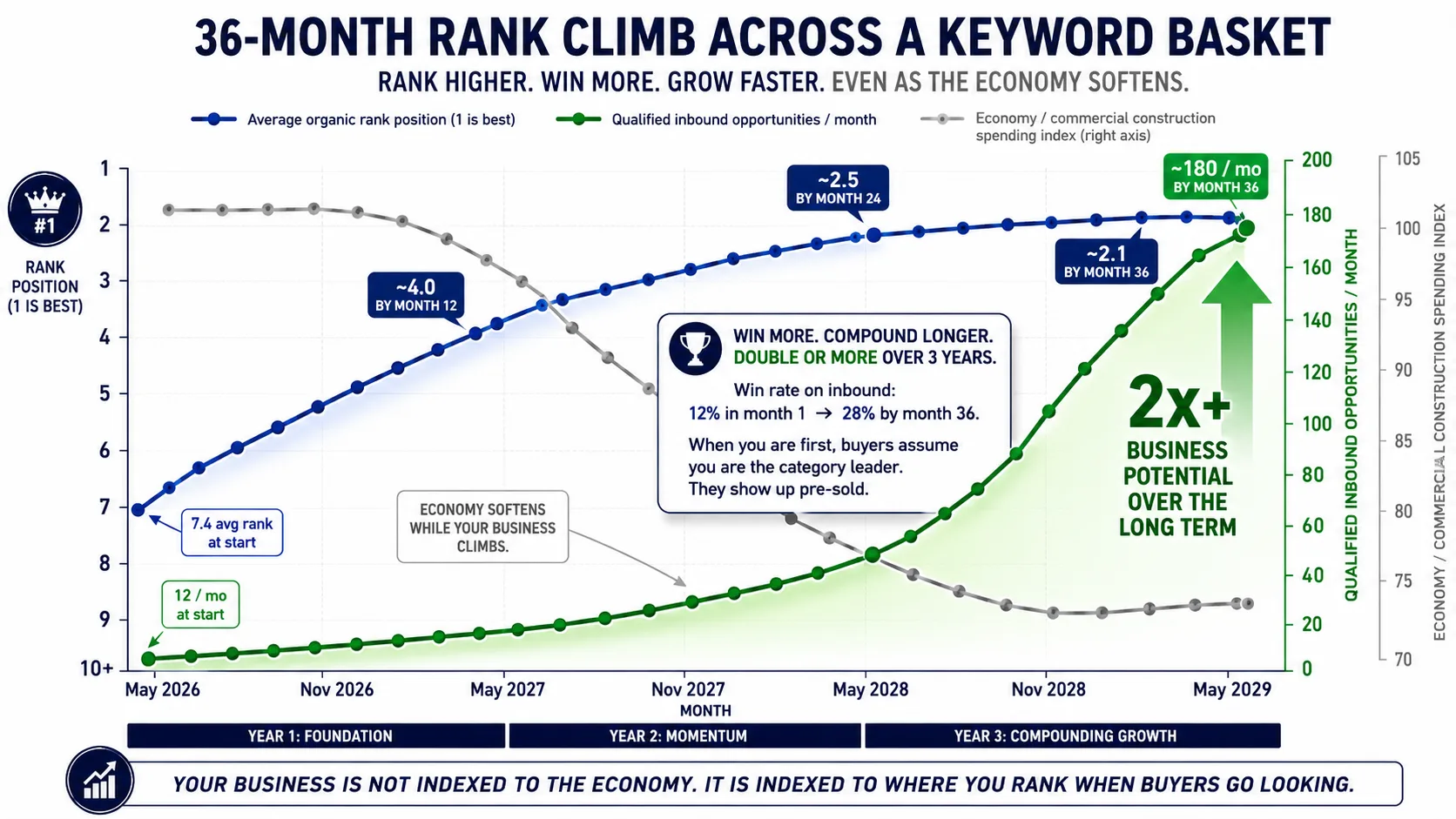
The traffic curve is the part most people obsess over, but the rank curve is what actually matters. Moving from an average position of 7 to an average position of 2 across a basket of relevant keywords is not a small change. It is a categorical change in your brand's visibility.
Position 7 to Position 1 Is a 10x Multiplier on Opportunities
Position 1 on Google captures about 28% of clicks. Position 2 captures about 15%. Position 7 captures about 3%. Position 11, the top of page 2, captures less than 1%. Only 0.63% of searchers ever click anything on page 2. Going from 7th to 1st on a single keyword roughly 10x's the number of buyers who see your brand. Do that across a basket of 30 to 50 keywords and the math gets serious fast.
There is a recession wrinkle to those numbers most people miss. In a downturn, buyers research more. They click further down the page, open more tabs, and request three or four quotes instead of one or two. But they still trust the companies at the top of the results. The top-ranked vendor still wins most of the deals. What the lower-ranked vendors get is the noise. Quotes that don't close. Spec sheets sent to procurement officers who already picked someone else and are using your number to negotiate them down. Your sales team burns hours on tire-kicking opportunities that were never coming your way. Higher cost-per-customer at exactly the time you can least afford it.
This is also the window for GEO, the discipline of getting cited by ChatGPT, Claude, Perplexity, Gemini, and Google's AI Overviews. 32% of digital leaders call GEO their top priority for 2026. 97% of leaders who invested say it works. The brands cited this year accumulate citation history the models reference for years. The brands that wait find their categories already locked up. Same dynamic as SEO in 2010.
You have 24 months. After that, you're not catching up. You're getting crushed.
What Actually Ranks for Your Category Right Now
Open Google. Type the search terms your buyers use. Count how far down the page you have to scroll before you see an actual manufacturer or distributor.
For a lot of B2B industrial categories, you don't see one on page 1 at all.
What you see is Alibaba, Amazon Business, Made-in-China.com, ThomasNet, Grainger. The same three or four marketplaces bundling thousands of generic listings, most of them cheap Chinese imports priced to win on cost alone. That is the floor your potential customers are starting from.
The buyer either clicks one of those listings, or they refine their search. The brands that win the refined searches are the ones whose websites built up real authority over years of marketing investment. The ones who skipped it stay invisible.
This is also what the AI is reading. When ChatGPT or Claude does its Google search in the background, it sees the same first page of marketplaces. If a real manufacturer doesn't appear, the AI shortlist defaults to "here are some marketplaces where you can buy this." The procurement officer never even hears your brand name.
Showing up on the second page is not a soft loss. It is being treated as if your company does not exist.
You Are Not Indexed to the Economy. Stagnation Is Your Enemy.
Most owners get this part wrong. They think the recession sets their ceiling. It doesn't. The recession sets the average. Half the companies in your category will do worse than average, half will do better, and a handful will come out of the downturn with more revenue than they went in.
Your business doesn't follow the economy. Your business follows your visibility, your CAC, and your share of voice relative to your competitors. If the economy contracts 5% and you grow your inbound 30%, you took 35 points of market share. The customers you win during a recession rarely go back. Procurement officers don't switch suppliers casually. Once you've earned the contract, you keep it for years.
Stagnation is the real enemy in a recession. Not the recession itself. The companies that close in 2028 won't close because the economy contracted. They'll close because they stopped marketing in 2026 and let their visibility flatline while everyone else kept going.
The Move
I was 20 in 2008. Nobody was going to ask my opinion about how the company should run, and I wouldn't have known what to tell them anyway. I was just an estimator pricing doors, taking on roommates, hoping the next bid would land.
You are in a different seat. You can see what is coming. You have time.
The phones in your shop aren't ringing as often as they were a year ago. You felt it before you read this article. Whirlpool said it out loud. McDonald's confirmed it. Bank of America put a number on it. The consumer is cracking, and the pipeline still looks fine because deals already underway have to get finished.
That changes in 2027.
You have 24 months to outrank your competition in Google, Claude, and ChatGPT. Enough time to build a cost-per-customer advantage so deep your less-prepared competitors can't catch up before the recovery. Enough time to grow market share while the economy contracts.
Hire an agency that handles SEO and GEO together. Today, not next quarter. You don't need to staff this internally, and you don't need to wait until you find a perfect senior marketer. A good agency already has the writers, the technical SEO operators, and the systems in place, and they can be producing content for you in the first month. Senior marketing services cost less in a downturn than they do in a boom. The companies that hire through the trough come out the other side with the search rankings, the AI citations, and the inbound pipeline their slower competitors will spend years trying to rebuild.
Open Google. Type your category. See who shows up.
Now open ChatGPT and do the same.
If it's not you in either one, you know what to do.
Start tomorrow.
Michael McDougald
Founder of Right Thing SEO, a math-driven SEO agency based in Nashville and Sarasota. Michael has spent 15+ years helping businesses achieve sustainable organic growth through data-driven strategies.
Learn more about Michael →