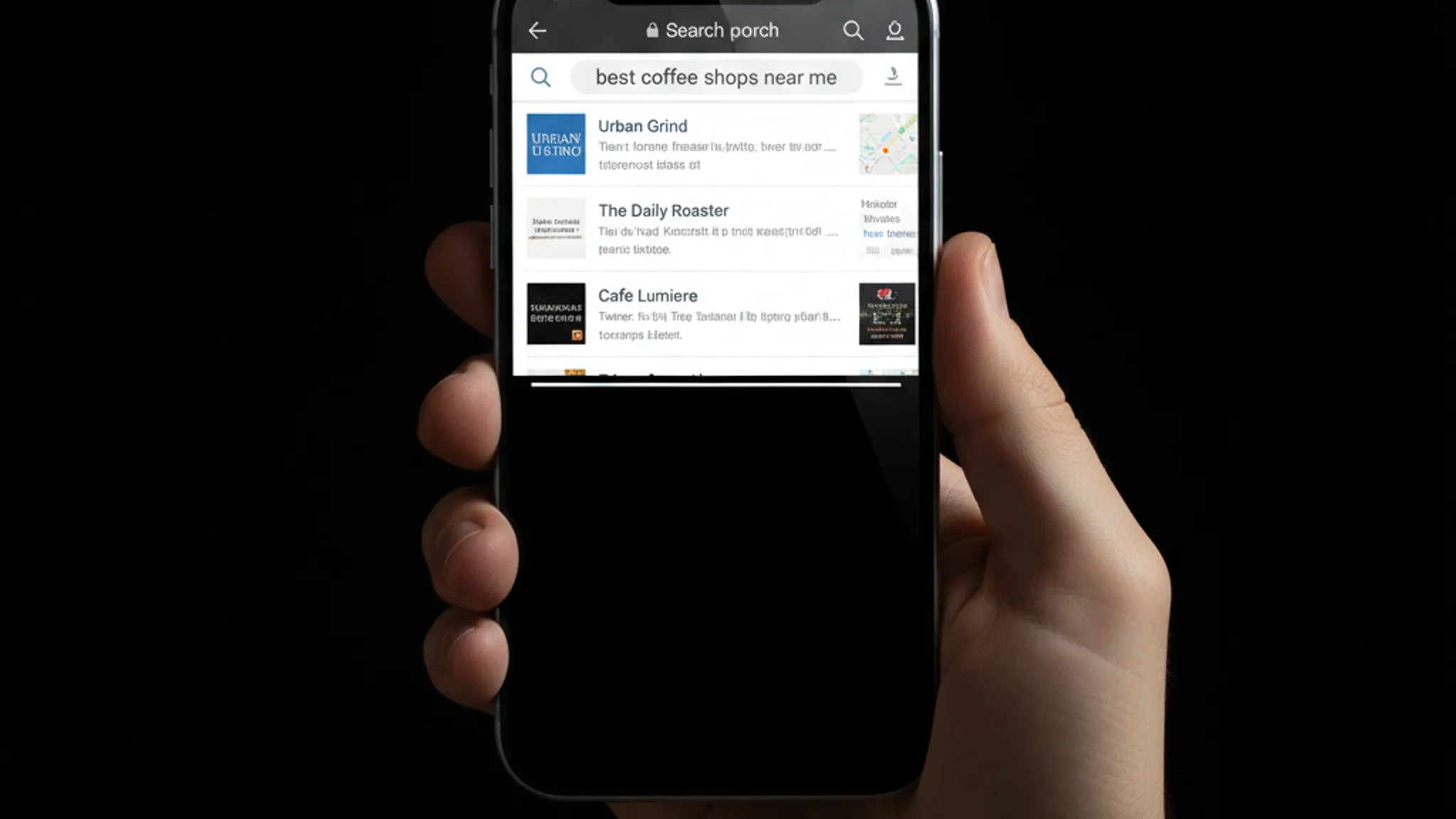
Nobody Scrolls Anymore
I watched a client's organic traffic drop 31% in four months. Their rankings hadn't moved. Their content was still good. Their backlinks were growing. The problem wasn't that they had fallen in search. The problem was that search had stopped sending people anywhere at all.
This is the era of zero click searches. Google answers the question before anyone touches a blue link. The entire concept of "ranking well" needs to be rethought from the ground up.
The Scroll Is Dead
For twenty years, the playbook was simple. Write good content. Optimize for keywords. Earn backlinks. Rank on page one. Collect traffic. Convert visitors. That model assumed something fundamental about how people used search: they scrolled, they scanned titles, and they clicked through to websites.
That assumption is now wrong.
SparkToro's 2024 clickstream study with Datos found that 58.5% of American Google searches and 59.7% of European searches ended without a single click. For every 1,000 searches in the United States, only 360 clicks make it to the open web. The rest stay inside Google's ecosystem or vanish into thin air, answered by AI Overviews, featured snippets, knowledge panels, and local packs.
And that was 2024. By early 2026, multiple analysts report zero click searches have climbed past 60%, with mobile zero click behavior reaching 77%. Google is becoming an answer engine, not a referral engine. The direction is unmistakable.
Why AI Overviews Changed the Math on Zero Click Searches
Featured snippets were the opening act. They trained an entire generation of searchers to expect answers right there on the results page. But featured snippets at least attributed a single source and offered a clear link. They were extractive, pulling exact text from one page.
AI Overviews are different. They're synthetic. Google's Gemini model reads dozens of pages, compresses their insights into a conversational paragraph, and presents it at the top of the SERP. The citations are tiny. The click incentive is minimal. The user gets what they need and moves on.
Bain and Dynata's December 2024 survey found that 80% of consumers now rely on these AI-generated zero click results for at least 40% of their searches, reducing organic web traffic by an estimated 15% to 25%. That isn't a rounding error. That's a structural shift in how the internet works.
And the numbers are accelerating. Searches that trigger AI Overviews now show an average zero click rate of 83%. Position one rankings in those results have seen click-through rates fall by more than 50% compared to traditional SERPs. Your content can be the definitive source on a topic and still generate almost no traffic from it.
The NavBoost Paradox
Here's the part that nobody in the zero click conversation is talking about, and it matters more than the statistics.
Google's own ranking system depends on clicks.
NavBoost, one of Google's most important ranking signals, was revealed during the DOJ antitrust proceedings. It uses 13 months of user interaction data, including clicks, long clicks, short clicks, and last clicks, to evaluate which results actually satisfy searchers. Google confirmed during testimony that clicks are one of their "three fundamental signals" alongside links and body text.
So Google built an answer engine that eliminates clicks, running on top of a ranking system that requires clicks to function. That's not a small contradiction. It's the central tension of modern search, and it has consequences that most SEO advice completely ignores.
When zero click searches dominate informational queries, the click data that feeds NavBoost shifts toward commercial and navigational intent. The algorithm starts tilting toward pages that generate transactions, not pages that educate. This creates a feedback loop where informational content gets less click reinforcement, ranks less confidently, and gets replaced even more aggressively by AI Overviews. The scroll doesn't just die for users. It dies for the algorithm too.
Your Website Isn't a Destination Anymore
The hardest pill to swallow in all of this is that your website's role has fundamentally changed. For years, we treated websites as the center of the digital universe. Every marketing channel was supposed to drive people there.
Siteimprove's Stephen Jeske describes this shift well: your website is evolving from being the initial research hub to becoming what he calls a "demand harvester" for highly qualified leads. The traffic that does reach your website is automatically more qualified because visitors have already done initial research through zero click results. They've already seen the AI Overview. They already know the basics. If they're clicking through to you, they want something deeper.
This completely reframes the content strategy conversation. You're no longer writing to attract first-touch visitors who need to learn what your business does. You're writing for informed prospects who are ready to evaluate whether you are the right choice. The content that wins in a zero click world is not the content that explains "what is X." It's the content that proves "why you should trust us with X."
What Actually Works in a Zero Click World
I spent the last 18 months testing strategies with clients who were getting hammered by declining organic traffic. Here's what I learned, and what the data actually supports.
Write for the machine, but only the parts that matter
AI Overviews pull from content that is structured clearly. Short paragraph blocks of 40 to 60 words that answer a specific question. Comparison tables. Definitional statements that begin with "X is..." followed by a concise explanation. This isn't about dumbing down your content. It's about making the critical sentences machine-readable so that when Google's AI synthesizes your page, your brand is the one cited.
Schema markup reinforces this structure. FAQ schema, HowTo schema, and Organization schema help search engines and large language models parse your content hierarchy. The data is clear: pages with proper structured data get preferentially selected for AI Overviews and featured snippet inclusion.
Build entity authority, not just keyword rankings
Google's Knowledge Graph maps connections between entities, the people, places, brands, and concepts that search engines actually understand. When someone searches for your topic, Google no longer just matches keywords. It evaluates whether your brand has a strong entity association with that concept.
This is where relevance engineering becomes critical. It's not enough to publish content about a topic. You need to build interconnected content clusters where every related question links to every related answer on your site. You need consistent entity signals across your website, your Google Business Profile, your social profiles, and third-party mentions. The stronger the entity web, the more likely AI systems are to reference you when generating answers.
Optimize for conversion, not just visibility
If your informational content is going to get summarized in AI Overviews without sending you clicks, then your click-generating pages need to work harder. Service pages, product pages, and case study pages are where the real SEO value lives now. These pages serve commercial and transactional intent that AI Overviews are less likely to fully satisfy.
Focus your measurement on revenue-generating pages. Filter out the blog traffic decline from your reports and look at what's actually driving leads and sales. This is a healthier way to measure SEO performance anyway, because it forces you to prove business impact rather than hiding behind vanity metrics like total sessions.
Treat AI platforms as distribution channels
ChatGPT, Perplexity, Google AI Mode, and other AI search platforms are not replacements for Google. They're additional surfaces where your brand can appear or disappear. Being referenced in an AI-generated response, even without a direct click, builds familiarity and trust that compounds over time.
The businesses that treat AI search optimization as a real channel, rather than a novelty, will have a massive advantage. The ones who write it off as hype will wonder why their pipeline dried up in 2027.
The Visibility Mindset
The biggest strategic error I see businesses making right now is measuring search success the same way they did three years ago. Click-through rate was a meaningful metric when people clicked. Organic sessions mattered when sessions led to first-touch conversions. Those metrics now tell an incomplete story.
Search Engine Land's framework for measuring visibility in a zero click world points toward better KPIs: share of SERP presence across all features for your keyword category, entity coverage in Knowledge Panels and AI responses, brand mention frequency in AI-generated results, and answer inclusion rate across different AI platforms.
These are not vanity metrics. They're leading indicators of the brand recognition that drives direct searches, branded queries, and high-intent conversions downstream. When someone sees your brand cited in three separate AI Overviews across a week, then searches your name directly the following Monday, that's not a coincidence. That's the zero click funnel working exactly as it should.
What This Means for Your Business
Zero click searches are not a temporary inconvenience. They're the permanent architecture of modern search. Google is not going to reverse course on AI Overviews. ChatGPT is not going to stop answering questions. The percentage of queries that end without a click is going to keep climbing.
The businesses that thrive in this environment are the ones that stop fighting the current and start building for it. That means content structured for machine extraction. Entity authority built across platforms. Measurement frameworks that capture visibility, not just visits. And a fundamental acceptance that your content's job is often to build trust in places where no one will ever click through to your site.
Nobody scrolls anymore. But everybody still searches. The question is whether they find you in the answer, or whether they find your competitor instead.
Michael McDougald
Founder of Right Thing SEO, a math-driven SEO agency based in Nashville and Sarasota. Michael has spent 15+ years helping businesses achieve sustainable organic growth through data-driven strategies.
Learn more about Michael →