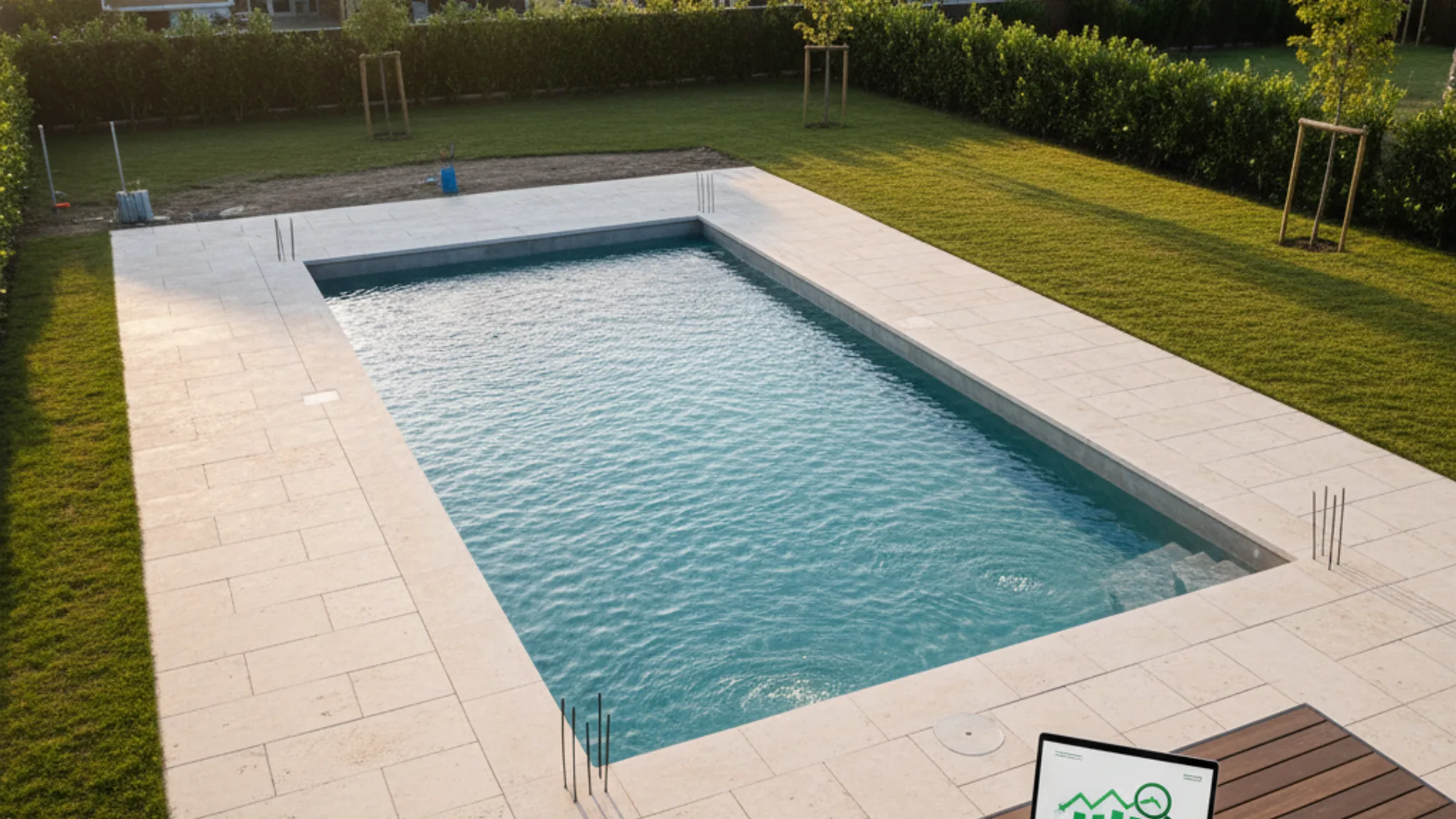
Pool Builder SEO in the Most Seasonal Home Services Market
The pool industry generates $16.5 billion annually in the U.S. alone, serving roughly 10.7 million residential pools. And yet most pool builders treat their website like a digital business card: a homepage, a gallery page, maybe an "About Us" that hasn't been updated since the company was founded. Then they wonder why the phone only rings when someone drives by the job site.
I've worked with enough home service businesses to see this pattern repeat itself. The pool builder who spent $40,000 on a truck wrap but won't invest in making their website findable on Google. The one who buys leads from HomeAdvisor at $80 a pop but has never heard of Google Business Profile optimization. I wrote about this lead-buying trap for home service contractors last month, and pool builders are some of the worst offenders.
Here's what they're missing.
What pool builder SEO actually requires
Pool builder SEO is search engine optimization applied to pool construction and pool service companies. It combines local search optimization, keyword-targeted content, and technical website improvements so that a pool company appears at the top of Google when homeowners search for pool installation, pool repair, or pool renovation in their service area. The seasonal demand curve makes pool builder SEO different from most home service verticals because search volume for pool-related queries can swing by 300% or more between January and May.
That seasonality is the thing nobody in the SERP is talking about. Every "pool builder SEO guide" I've read online treats this industry like it's plumbing or HVAC, as if demand is roughly consistent year-round. It isn't. And that one fact should reshape your entire SEO strategy.
Seasonality is the variable that changes everything
Google doesn't just rank pages based on static relevance signals. A patent filed by Google on document scoring describes how the search engine identifies "repeating traffic patterns or changes in traffic patterns" and adjusts its scoring of documents during and outside of those seasonal periods. If your pool building website only publishes content during the busy season, Google sees a site that goes dormant for half the year. That's not the behavior of an authoritative business.
How off-season content builds pool SEO momentum
The smart play is to reverse your content calendar. In the off-season (October through February in most markets), you should be publishing pool design inspiration content, renovation planning guides, and cost comparison articles. These capture the early-stage researchers, homeowners who are thinking about a pool for next spring but haven't committed yet. By the time March rolls around and search volume spikes, your pages have been indexed, accumulated backlinks, and built topical authority.
Pool companies that only do SEO from March to September are outbid by competitors who built their content foundation during the months nobody was looking.
Local SEO is where the money actually lives
Pool builders are inherently local businesses. Nobody drives 200 miles to hire a pool contractor. This means local search optimization is the entire strategy, not a side project.
Google's local algorithm runs on three factors, described in patent US8046371B2 ("Scoring local search results based on location prominence"): proximity, relevance, and prominence. Proximity is geographic distance between the searcher and your business. You can't control that. Relevance is how well your Google Business Profile and website content match the search query. You can control that completely. Prominence is a composite score based on your website's link profile, review count and quality, citation consistency, and how often your business is mentioned across the web.
Google Business Profile optimization for pool contractors
For pool builders, the local SEO checklist looks like this:
Claim and fully complete your Google Business Profile. Add every service you offer (pool construction, pool renovation, pool repair, spa installation) as a separate service listing. Upload project photos monthly. Respond to every review.
Keep your NAP (name, address, phone number) consistent across every directory where your business appears. BrightLocal and similar tools can audit this, and inconsistencies here are one of the most common local SEO failures I see in the pool industry. When Google finds three different phone numbers for the same company across Yelp, Angi, and the BBB, it doesn't trust any of them.
Collect reviews relentlessly. Not just Google reviews, though those matter most. A pool builder with 150 Google reviews and a 4.8 rating will outrank a competitor with a better website but only 12 reviews. The prominence signal from reviews is that strong.
On-page SEO mistakes pool builders keep making
Most pool builder websites have two problems. First, they target only transactional keywords like "pool builder near me" or "pool installation [city]." Those are important, but they're also the most competitive. Second, they produce almost no content that demonstrates actual expertise.
Google's quality rater guidelines evaluate content through the lens of E-E-A-T: experience, expertise, authoritativeness, and trustworthiness. For a pool builder, that means your website should answer the questions homeowners actually ask before they hire someone. How much does an inground pool cost in your area? What's the difference between fiberglass and gunite? How long does pool construction take? What permits are required?
Each of those questions is a long-tail keyword opportunity. The keyword "pool builder seo" has a search volume of 250/month at KD 2, but related terms like "pool companies near me" pull 22,200 searches monthly. Your content strategy should cover the full funnel, from informational articles that establish expertise all the way down to service pages that convert phone calls.
Content optimization and technical SEO basics
Title tags should contain your target keyword near the front. Meta descriptions should be written as persuasive copy, not keyword-stuffed summaries. Header tags (H1, H2, H3) need to include keyword variations naturally. Internal linking between your service pages, location pages, and blog content creates the kind of topical architecture that helps Google understand what your site is about. And make sure your site works on mobile. Over 60% of pool-related searches happen on phones, and Google uses mobile-first indexing, so a pool builder website that loads slowly on a phone is invisible to the algorithm regardless of how good the content is.
I've seen this same content gap in healthcare SEO and real estate SEO. The businesses with the deepest expertise produce the thinnest content, because they assume everyone already knows what they know. They don't. That gap between what you know and what your website says is where your competitors are stealing your customers.
Building authority when you're a local pool company
Off-page SEO for pool builders doesn't require a massive link building operation. It requires being a real, visible business in your community.
Sponsor a local swim team and get a backlink from their website. Get quoted in a local news article about pool safety. Partner with a landscaping company and exchange testimonials with links. None of this is exotic. It's what good local businesses have always done, except now the handshake happens through a hyperlink.
Industry directories matter too. The Association of Pool and Spa Professionals, Houzz, and HomeAdvisor (for the listing, not the leads) all provide relevant backlinks. Social media profiles on Facebook, Instagram, and Pinterest create additional citation signals. Google's algorithm uses social profiles to verify that a business is legitimate, even though social links themselves don't pass traditional link equity.
The pool companies I've watched succeed with SEO over 12-24 months are the ones that combine consistent content production with steady off-page authority building. They do both at the same time, and they don't stop when results start showing.
How to measure what actually matters
If your SEO provider is sending you a report full of keyword rankings and nothing else, you're getting half the picture. The metrics that matter for pool builder SEO are organic traffic (tracked in Google Analytics), click-through rate from search results (tracked in Google Search Console), and conversion rate from organic visitors to phone calls or form submissions.
SEO leads close at 14.6% compared to 1.7% for outbound leads like direct mail or print advertising. That's not a marginal difference. It's an order of magnitude. But the timeline to see meaningful results is 6-12 months for most pool builders, with a second inflection point between months 16 and 24 when high-value keywords reach page one positions.
The pool builders who win at SEO are the ones who treat it the way they treat pool construction. You plan before you dig, you build on a solid foundation, and you tell the customer upfront that this isn't a weekend project.
Katrina Kendall
Content Strategist at Right Thing SEO, where she helps business owners sound like the experts they already are. Her focus is on translating real-world experience — the kind that lives in a founder's head but never makes it onto the page — into content that satisfies Google's E-E-A-T standards and actually converts. Before joining Right Thing, she spent six years in B2B content strategy, where she got tired of watching brilliant operators get outranked by generic blogs written by people who'd never done the work.