
The Trust Cascade That Turns One Authoritative Mention Into AI Search Visibility
Last fall I watched a client go from invisible to quoted across three different AI platforms because of one paragraph in a trade publication. Not a campaign. One mention. I had been tracking their brand inside ChatGPT, Perplexity, and Gemini for weeks, and the needle sat at zero. Then a niche industry outlet named them in a roundup, described what they did in a single clean sentence, and within about three weeks that exact description started showing up in AI answers I had nothing to do with.
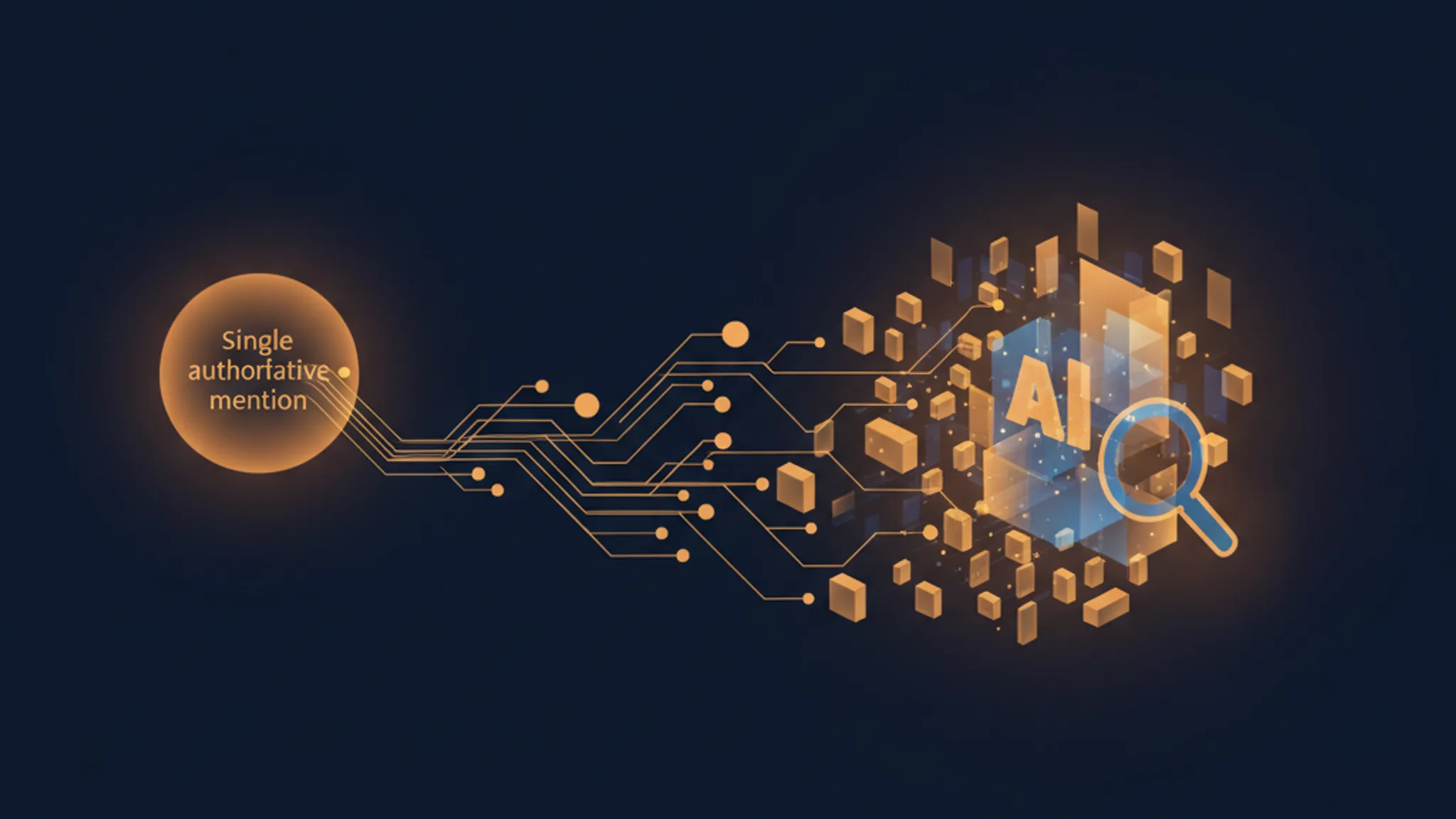
That is the trust cascade, and it is the most misunderstood mechanic in AI search right now. Most advice treats AI search visibility as a content problem you solve on your own pages. It is a reputation problem that the open web solves for you, one authoritative mention at a time. I wrote the longer version of this argument in our AI search survival manual. This piece is about the mechanism underneath it.
What AI search visibility actually is
AI search visibility is how often AI search platforms name and cite your brand in their answers. It is not a ranking position. AI search visibility is a trust score that ChatGPT, Perplexity, Gemini, and Google AI Overviews infer from how the open web describes your brand. The strongest single input to that visibility is brand mentions, which AI Overview visibility at 0.664, ahead of backlinks.
Read that number again, because it reorganizes the playbook. For two decades the authority currency of search was the link. In AI search the currency is the mention, linked or not. These systems are not counting votes the way the old algorithm did. They read what the web says about your brand and decide whether enough credible sources tell a consistent story to risk naming you in an AI-generated answer.
The trust cascade starts with one authoritative brand mention
A single mention in the right place does not sit there as one data point. It cascades. The same sentence gets ingested into training data, echoed by aggregators, picked up by the retrieval layer that grounds live answers, and repeated back to people who never saw the original. One authoritative mention becomes many citations because the systems feeding AI search all drink from overlapping pools of content.
This is older than ChatGPT. Google's PageRank patent described authority as something that flows through a graph of citations, where a link from a trusted source passes value forward to whatever it points at. Strip out the hyperlink and you have the same idea running through AI search engines. A trusted source mentioning your brand passes trust forward, and these platforms treat that passed trust as evidence you belong in the answer.
The trust half has a paper trail too. Google researchers published Knowledge-Based Trust, a method for scoring how trustworthy a web source is based on whether the facts it states are corroborated elsewhere, tested against 2.8 billion facts. That logic carries straight into AI search. A brand the web describes consistently looks trustworthy. A brand the web contradicts or ignores looks like a risk the model would rather not name. When I pulled my client's citation data after that one trade mention, the cascade was obvious. The platforms were not reading their site harder. They were reading what an authoritative third party said and treating it as settled.
Why brand mentions beat backlinks as a visibility signal
The Ahrefs study covered 75,000 brands, and brand mentions beat backlinks by roughly three to one as a predictor of AI visibility. That gap matters because most companies still spend their off-site budget chasing links and ignore the mentions that move the needle harder. An unlinked mention in a respected publication still pulls weight. It works as a soft authority signal that tells AI systems your brand is a real entity that credible people talk about.
So learn what counts as a mention. A review on a third-party platform is a brand mention. A podcast transcript that names your brand is a brand mention. A roundup, an analyst note, a Reddit thread, a quote in a journalist's article, all of them are signals these systems read. The ones that carry the most weight describe your brand as an authority on a topic rather than dropping the name in passing. Sentiment and context matter as much as frequency, because the model is learning what your brand is known for, not just that it exists.
Here is what a wasted mention looks like. A press release your own brand published, syndicated to fifty low-trust sites, reads as noise. Fifty identical brand mentions from sources nobody trusts do not add up to one mention from a source the engines already cite. The authority signals that move AI search visibility are the ones an independent, credible source chose to publish about your brand, and those are the mentions worth chasing.
The reason sits in how these systems read content. They are not crawling for anchor text. They build a picture of who your brand is, what it does, and whether the ecosystem treats it as a leader or a stranger. A mention that names your brand next to the topics you want to own does that work whether or not it carries a link. Backlinks still help, and I am not telling anyone to stop earning them. The brand mention is the part the AI weighs most, and the part most teams under-invest in.
Backlinks still help, and I am not telling anyone to stop earning them.
This also explains why a technically perfect site stays invisible. You can have clean schema, fast pages, and deep content, and still never get named, because nothing off your domain corroborates the story. AI search does not reward the loudest publisher. It rewards the most corroborated one, and corroboration is a brand signal that lives on other people's pages. Traditional SEO taught us to optimize the page. AI search rewards the off-site signals around it, and those signals are mostly brand mentions you do not directly control.
How brand mentions cascade across ChatGPT, Perplexity, and Gemini
Each platform sources differently. ChatGPT leans on encyclopedic references and its training corpus. Perplexity rewards freshness and pulls hard from Reddit and recent news. Google AI Overviews lean on organic strength plus structured data. On the surface that looks like three separate problems. Underneath, the engines share a substrate. Wikipedia, major news, large forums, and the same handful of authoritative publishers feed all of them. So an authoritative mention placed well does not lift your visibility in one platform. It seeds the pool every platform drinks from.
That is why the cascade crosses platforms even though most individual citations do not. The mention is the asset that travels. When a credible source describes your brand cleanly, that description propagates into the training data ChatGPT learned from, the live index Google's Gemini grounds against, and the fresh content Perplexity favors. I have watched the same sentence surface in three AI engines within a month of a single placement, which is exactly what you would expect if one mention is feeding a shared corpus rather than three isolated ones.
Google does not pull a brand name at random. Google's grounding layer still decides which sources to trust for a given query, a process I broke down in how AI Overviews decide which sources to cite. The cascade gets your brand into the candidate pool. Whether you get named on a specific answer depends on relevance and trust at the moment someone asks.
What gets your content cited when buyers ask AI questions
Earning the mention is half the job. Your own content still has to be the kind of content these systems can lift and quote. Princeton researchers tested this in their Generative Engine Optimization study and found that adding citations, statistics, and direct quotations boosted visibility in AI-generated answers by up to 40 percent. Not vague best practices. Specific, measurable structure that turns a page into something quotable.
Answer the questions buyers actually ask
The pattern that works is the one AI systems extract without effort. Answer the question in the first sentence under a heading that matches how people phrase it. Keep each section on one idea so the retrieval layer pulls it cleanly. Add the statistic, name the source, and make the claim checkable. This is partly an embeddings problem, because the platforms match your passage against the buyer's questions in vector space before they quote it, which is the mechanic behind how embeddings predict which content will rank. A focused passage scores higher than a meandering one covering five topics at once. The content that earns brand mentions and the content that gets cited in AI-generated answers tend to be the same content, because both reward specific, sourced writing that is easy to quote.
Why traditional SEO content gets skipped
Traditional SEO content fights all of this. Keyword-dense, broad, hedged pages were built to rank in a list of ten links. AI search does not want the page. It wants the one sentence it can lift into an answer. Semrush's top-ten vs. AI citations study and found only about 44 percent overlap, with AI-generated referral visitors converting roughly 4.4 times better than traditional organic ones because they arrive already convinced. Ranking and being cited are now two different jobs, and the content that wins one often loses the other. Most teams keep writing for the old search engines and wonder why the new ones skip them. Their content still ranks in Google, and still never appears in the AI-generated results their buyers actually read.
How to engineer the cascade for AI search visibility
Stop thinking in campaigns and start thinking in placements. One authoritative mention in a publication your buyers and the platforms both trust is worth more than fifty thin guest posts. Find the sources that already get cited in your category, earn a clean description of your brand in one of them, then make that same description consistent everywhere else your brand appears so the systems stop second-guessing who you are. Consistency is itself a trust signal, and inconsistent positioning is one of the fastest ways to confuse the engines about what your brand does.
Reviews compound the effect. Third-party review profiles give AI systems more corroborating sources for your brand, and the lift is steep once you cross from nothing to something. Then distribute. The same original research, repackaged into digital PR, earned media, directories, and expert commentary, hands the cascade more places to start. Digital PR is the engine that manufactures the authoritative mentions AI search runs on. Treat it that way. This work lives outside your content management system and inside your digital reputation, which is why I run it as enterprise SEO consulting rather than a publishing checklist. The brands winning AI search visibility are not the ones publishing the most content. They are the brands the web corroborates the most.
Measure the cascade the way the platforms experience it. Take the questions your buyers actually ask, run them through ChatGPT, Gemini, Perplexity, and Google AI Overviews, and record whether your brand shows up, which sources the answer cites, and how those answers describe you. That prompt set is your baseline. When a new authoritative mention lands, the AI-generated answers shift, sometimes within days on Perplexity and within weeks on the others, and you can watch one mention ripple into citations across platforms. A third-party AI visibility tracker can automate the prompt runs and report share of voice, but the manual version teaches you more about why these systems pick the brands they pick. Traditional rank tracking will not show you any of this, because the questions live in a chat box, not a results page.
The window is the reason to move now. AI search is concentrating citations among a small set of trusted brands per topic, and that set hardens over time. The brand that earns the authoritative mention this quarter compounds an advantage the brand that waits will struggle to claw back. Early authority in AI search behaves like early authority always has. It accrues to whoever shows up first and gets described well.
None of this rewards the loudest voice in the room. It rewards the most trusted brand. If you want to be named in the answer, stop optimizing only the page and start earning the mention that teaches every AI platform your brand is worth quoting.
By Michael McDougald
Michael McDougald
Founder of Right Thing SEO, a math-driven SEO agency based in Nashville and Sarasota. Michael has spent 15+ years helping businesses achieve sustainable organic growth through data-driven strategies.
Learn more about Michael →