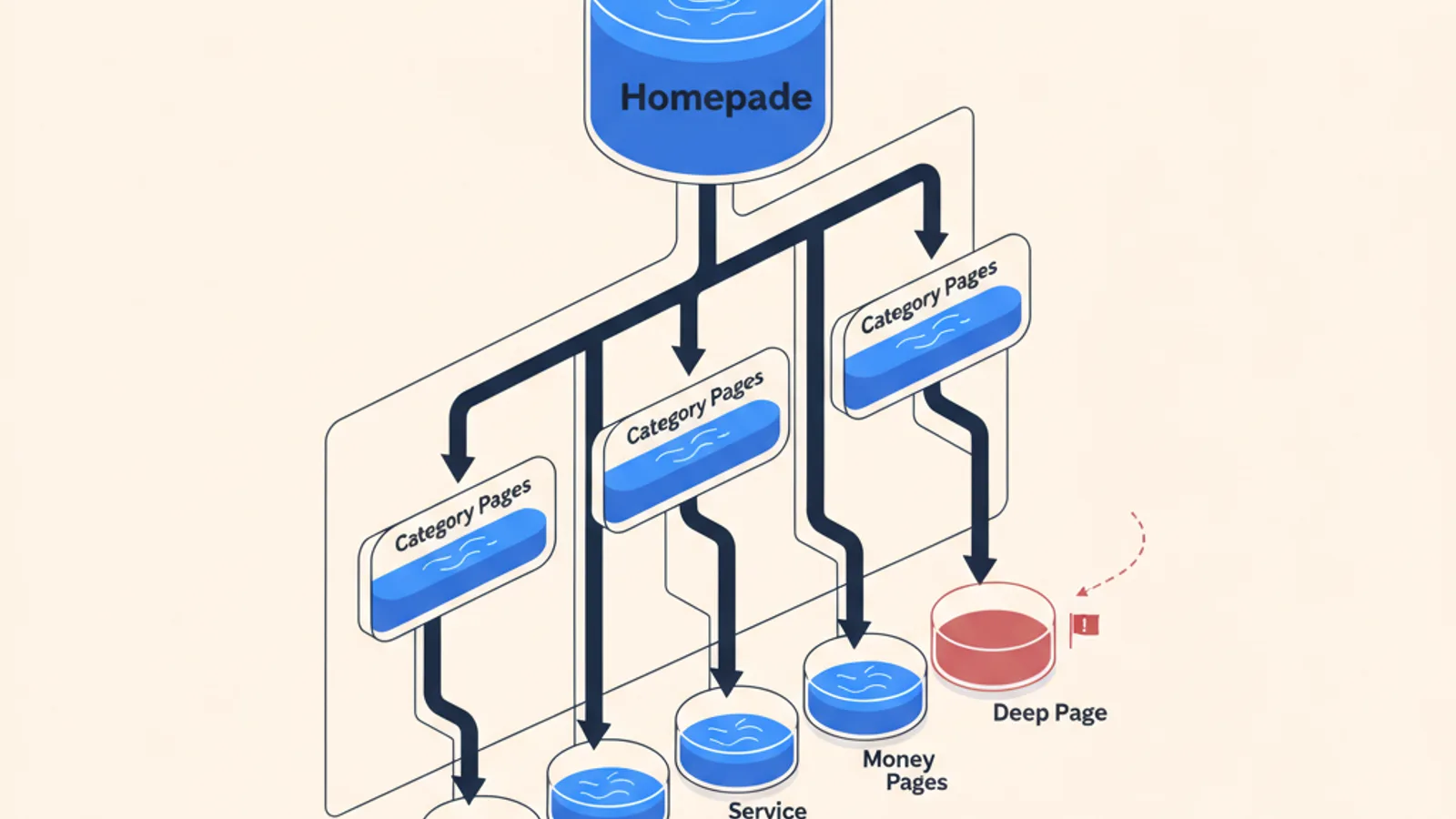
Here is how PageRank works, in plain English. PageRank works by treating every link as a vote. When one web page links to another, it passes along a share of its own authority, and a page that earns more of those votes from more trusted pages is judged more important and ranks higher. That recursive idea, important pages making the pages they link to important, is how PageRank works, and a version of it still runs inside Google today.
Every few months someone announces that links are dead and PageRank is a relic. Then a Google engineer confirms, on the record, that PageRank is still part of the core ranking system, and the cycle starts over. So let me settle it. PageRank is alive. The public score that used to sit in the old Google Toolbar is gone, retired in 2016, but the algorithm underneath it never left. The real question in 2026 is not whether PageRank exists. It is where your link equity flows once it reaches your site, and where it quietly leaks out before it ever gets to the pages you care about.
The short version
PageRank flows through links like water through pipes. Each page passes a share of its authority across its outbound links, and that value decays with every click of distance from the source. External links pour equity into your site. Internal links route it. Pages far from the entry point, or cut off by a sloppy migration, inherit far less. That is why your site architecture, not just your backlink count, decides who ranks.
That is the whole game. Now let me show you how it works, why it changed, and what to actually do about it.
THE BASICS
What PageRank Actually Measures
PageRank was created in 1996 by Larry Page and Sergey Brin while they were at Stanford. The name is a pun on Larry Page and on the word "webpage," which tells you they had a sense of humor about it. The idea was simple and, at the time, radical. Instead of ranking pages by how many times a keyword appeared, rank them by who links to them.
Think of every link as a vote. When one page links to another, it is vouching for it. A page with lots of votes is probably important. Not all votes count the same, and that is what made PageRank work. A vote from a page that itself has lots of votes carries more weight than a vote from a page nobody links to. Authority flows from the authoritative, which is what makes the whole thing recursive.
One detail to lock in early, because most people get it backwards. PageRank is calculated for a page, not a whole site. Your homepage might be strong while a service page three clicks away is starving. (This is also why a homepage so often tries to rank for everything and ranks well for nothing, a problem I dug into in why your homepage SEO has an identity crisis.) Google does compute some site-level signals too, and we will get to those, but classic PageRank is a per-page number. Keep that in your head. It matters more than almost anything else in this article.
THE MATH
The PageRank Formula
You do not have to love math to use this, but the formula is worth seeing once, because it explains a lot of real-world behavior in a single line. Start with the simplest case. If pages B, C, and D all link only to page A, then:
PR(A) = PR(B) + PR(C) + PR(D)
A inherits the full PageRank of everything pointing at it. Real pages link to more than one place, though, so you have to divide. Each linking page splits its PageRank across all of its outbound links:
PR(A) = PR(B)/L(B) + PR(C)/L(C) + PR(D)/L(D) + ...
where L(B) is the number of outbound links on page B. This is the most important move in the whole algorithm. A strong page that links only to you passes its full vote. The same page linking to one hundred places passes you a hundredth. Outbound links divide the equity.
Now add the damping factor, which gives the version closest to what Google actually published in 1998:
PR(A) = (1 - d)/N + d ( PR(B)/L(B) + PR(C)/L(C) + ... )
Here d is the damping factor, about 0.85, and N is the total number of pages. The (1 - d)/N term hands every page a small base amount of PageRank no matter what links to it. That is the teleport, and it is what the next two sections are about. The d in front of the sum scales down how much authority flows through the links themselves.
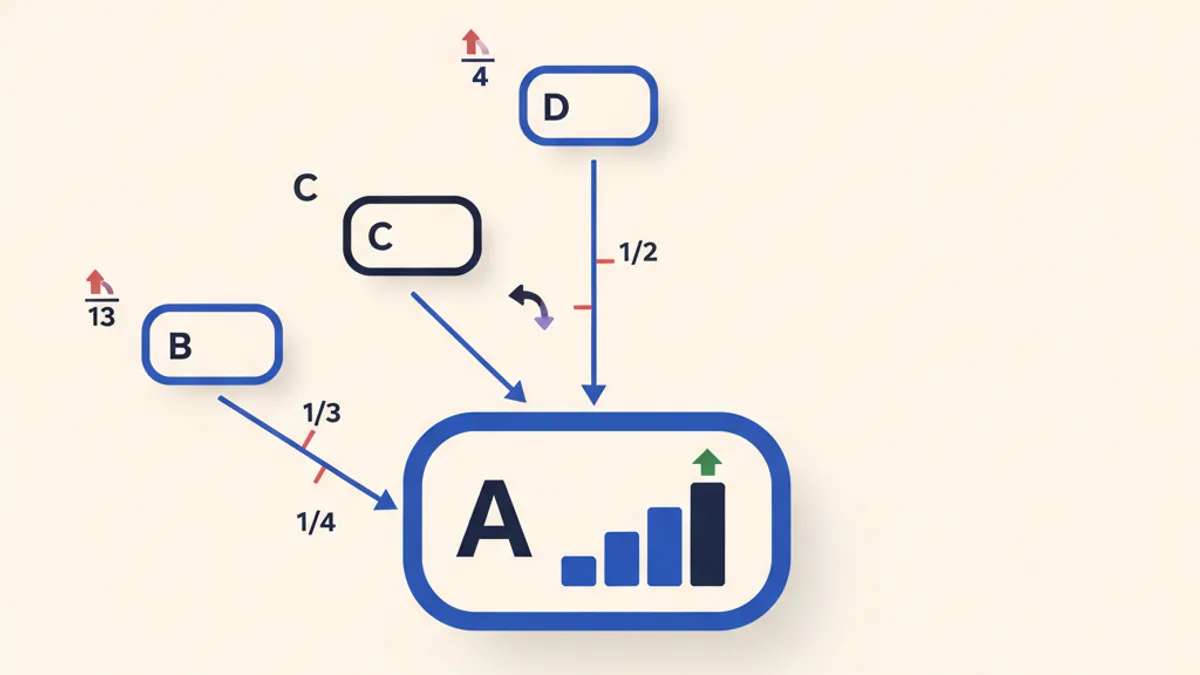
A quick worked example makes it click. Say pages B, C, and D each have a PageRank of 0.25 and each links only to page A. Page A receives 0.25 plus 0.25 plus 0.25, for 0.75. Now suppose B also links to C, and D links to three places instead of one. B splits its 0.25 between two targets, so A gets 0.125 from B. D splits its 0.25 across three links, so A gets about 0.083 from D. Same pages, same authority, different routing, and A ends up with a very different score. That is the whole concept of flow in miniature.
If you prefer to think about the whole web at once, the same thing is written as a single matrix equation:
R = (1 - d)/N · 1 + d M R
R is the vector of every page's PageRank, 1 is a column of ones, and M is the Google matrix: a map of which pages link to which, with each page's outgoing weight split across its links. Written this way, PageRank is the principal eigenvector of that matrix, which is the mathematician's way of saying it is the stable state of the system, the stationary distribution of a Markov chain. You do not solve it in one pass. You compute it by power iteration: start every page at an equal value, run the equation, feed the result back in, and repeat until the numbers stop moving by more than a tiny threshold. That settling is the convergence the damping factor exists to guarantee.
One footnote for the precise reader. The first formula in this section, the one without N, was the form in the original paper, and it does not behave exactly like a probability distribution across a large web. Dividing the base term by N, as above, fixes that and makes all the scores sum to one. It does not change how you should think about it: authority enters, splits across outbound links, and accumulates on the pages that collect the most.
THE MODEL
The Random Surfer Model
The formula has a story attached to it, and the story is where the random surfer comes in. People constantly mash the random surfer and the damping factor into one idea. They are two different things, so let me pull them apart.
The random surfer model is the mental picture of how PageRank behaves. Imagine someone who lands on a page and clicks links at random, then clicks another, then another, wandering the web forever. Over time, the pages this random surfer visits most often are the important ones, because lots of well-connected pages funnel them there. PageRank is, formally, the probability that this random surfer is sitting on any given page at a random moment. More inbound links from strong pages means a higher chance the surfer ends up on you. That is the model. It is a description, not a knob you turn.
THE MODEL
The Damping Factor
The damping factor is the knob, and it exists to solve a real mathematical problem. Our random surfer would not actually click forever. At some point they get bored, abandon the trail, and jump to a brand new page out of nowhere. The damping factor, usually set to 0.85, is the probability that they keep clicking. The remaining 0.15 is the probability that they teleport somewhere random instead.
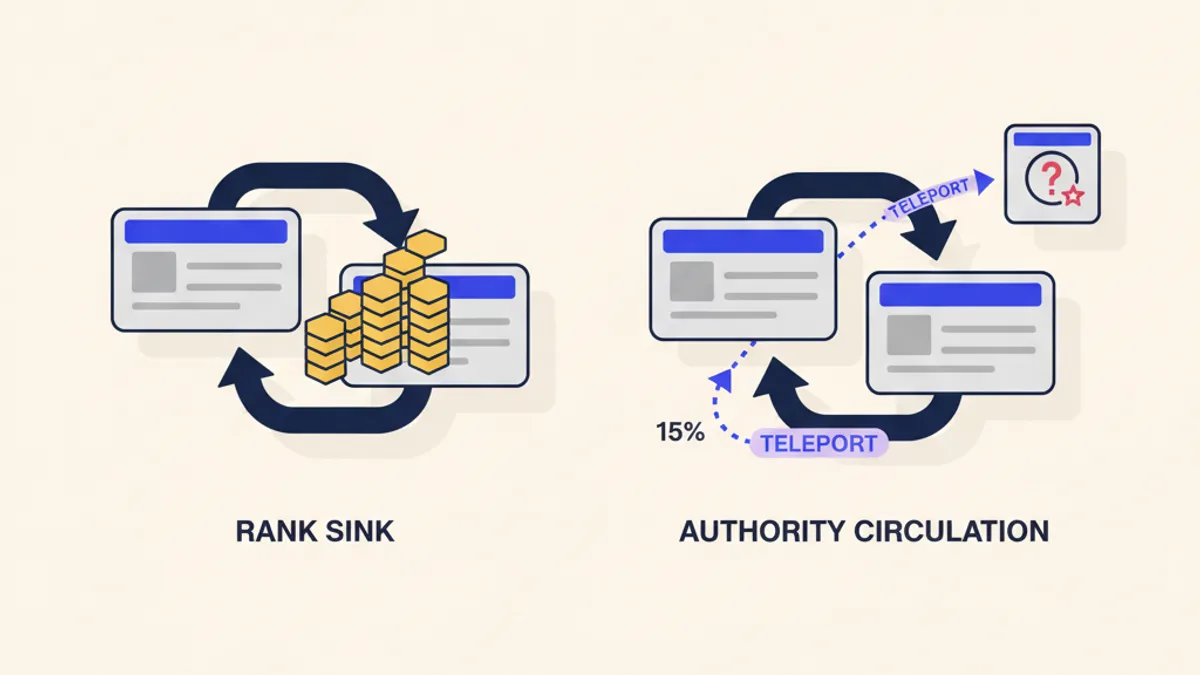
Why does that 15 percent escape hatch matter? Because without it, the math breaks. Picture two pages that link only to each other and nothing else. Our surfer wanders in, and now they are trapped, bouncing between those two pages while their PageRank climbs with every pass and never flows back out. SEOs call this a rank sink, or a spider trap. Pages with no outbound links at all, called dangling nodes, cause a related problem: they absorb authority and pass none along. Left alone, these loops and dead ends let rank pile up infinitely in the wrong corners and the calculation never settles on a stable answer. The teleport fixes it. By giving the surfer a constant small chance to jump out to a random page, the damping factor guarantees authority keeps circulating, no page can hoard it, and the whole system converges on a stable set of scores.
The exact value is a balance, and it is worth understanding what happens when you push it either way:
- Too high (close to 1). The surfer almost never teleports, so the link structure dominates and the random escape barely matters. Convergence slows down, the math needs far more iterations to settle, and the system becomes much more sensitive to those rank sinks and spider traps. At a damping factor of exactly 1, the calculation may never converge at all, because the dead ends absorb everything.
- Too low (close to 0). Teleporting dominates, so the surfer is basically ignoring links and hopping to random pages. PageRank flattens toward giving every page the same score, and the link graph stops meaning anything. At 0, a page's rank does not depend on its links at all.
Brin and Page landed on 0.85 because it sits in the sweet spot: enough weight on real links to be meaningful, enough teleporting to keep the math stable and fast. You will never set this number yourself. But knowing why it exists explains a lot about why isolated, poorly linked pages on your own site struggle to hold any authority.
THE MODEL
The Reasonable Surfer: Why Not Every Link Passes the Same Value
The classic random surfer treats every link on a page as equally likely to be clicked. Anyone who has used the internet knows that is not how people behave. You are far more likely to click a bold link in the middle of an article than a gray "Terms of Service" link in the footer. Google knows it too, and patented it.
In 2010 Google was granted the Reasonable Surfer patent (US7716225B1, with a later continuation in 2016). The premise is straightforward: when a surfer hits a page full of links, they follow some with higher probability than others, and a link should pass authority in proportion to how likely it is to actually get clicked. The patent literally names the kinds of links nobody clicks: "Terms of Service" links, banner advertisements, and links unrelated to the document.
So the reasonable surfer assigns each link a click probability based on its features, and that probability becomes a multiplier on the equity the link passes. Same idea as distance decay: a link does not transfer its full value, it transfers a percentage. The features that move that multiplier include:
- Position on the page. A link in the main content beats a link in the footer or sidebar. A navigational link in the menu carries differently than boilerplate repeated across every page.
- Height in the content. A link near the top of the article, above the fold, is more likely to be clicked than one buried at the bottom, so it passes more.
- Visual prominence. Font size, bold, color contrast. A link styled to stand out gets clicked more. A link the same color as the body text does not.
- Anchor text and word count. What the link says, and how many words it uses, both factor into how clickable it looks.
- Topical relevance. A link pointing to a page about the same subject is more likely to be clicked by an interested reader, so it passes more equity. Relevance is something Google measures directly.
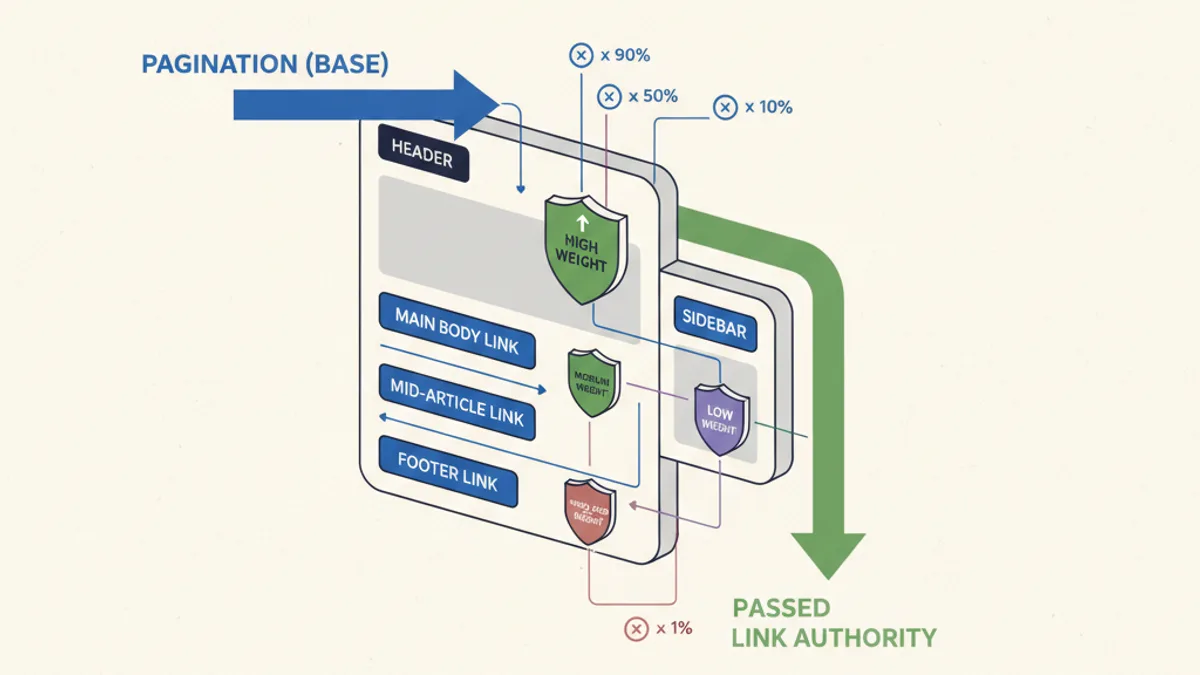
That last one connects directly to paid links. A link that is off topic, sitting in content with nothing to do with its destination, looks exactly like the banner ad the patent flags as unlikely to be clicked. Which means an irrelevant paid placement does not just risk a penalty. Under the reasonable surfer, it passes less of its PageRank in the first place, because the model already expects nobody to click it. Relevance is not a bonus. It is a multiplier on everything.
Keep this multiplier idea in your pocket. It shows up again when we get to the 2024 leak.
THE FLOW
How PageRank Flows Through a Website
External links decide how much equity enters your site. Internal links decide where it goes once it is inside. I think of internal links as the plumbing. Backlinks fill the tank. Your internal linking is the pipework that carries that water to specific rooms. If the pipes do not reach the kitchen, the kitchen stays dry no matter how full the tank is.
Most sites pour the majority of their external equity into one or two pages, usually the homepage and maybe a flagship post. That is normal. The homepage almost always has the highest PageRank on a site. The question is what happens next. From the homepage, equity flows out through whatever links sit on it, then through the links on the next pages, decaying a little at each hop because of the damping factor we just covered.
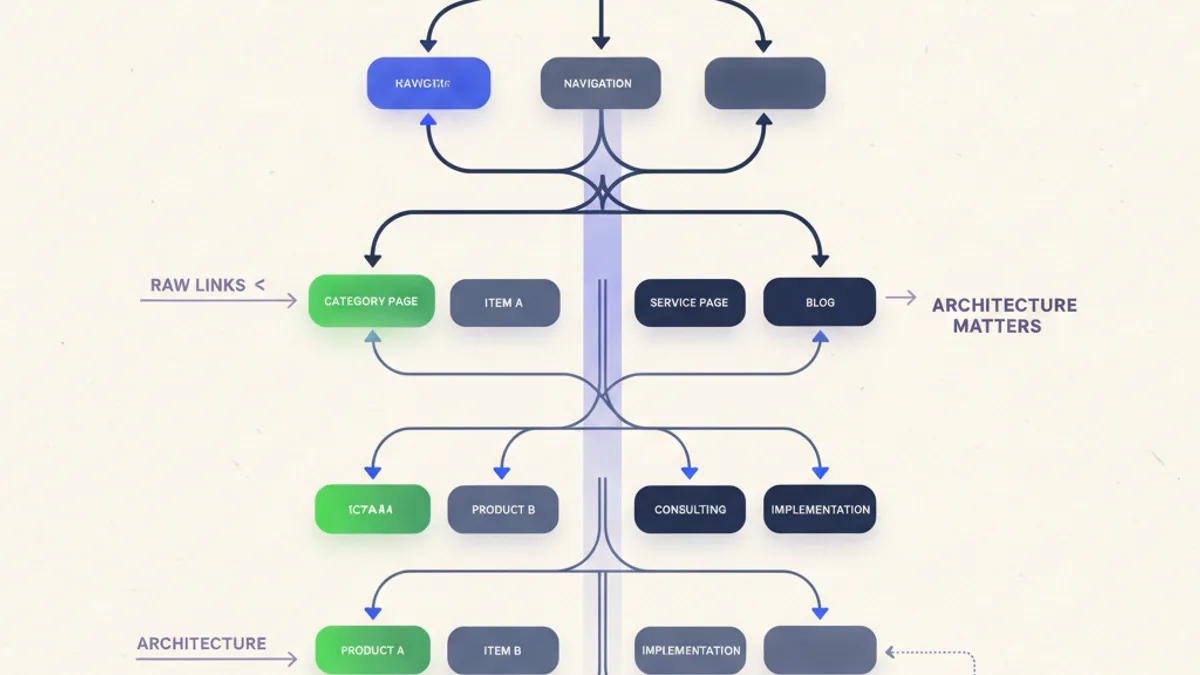
This is why two pages with identical content can rank completely differently. One sits in the main navigation, one click from the homepage. The other is buried five clicks deep, reachable only through a pagination trail nobody links to. The first inherits real authority. The second is technically on your site and practically invisible.
On one audit, a client's highest-margin service page was the single weakest page in their internal structure. Every blog post linked sideways to other blog posts. Nothing of value linked down to the page that actually made money. We were not missing backlinks. We were failing to route the equity we already had. A dozen contextual internal links later, from strong posts straight to that page, and it climbed without a single new backlink.
A few principles fall out of this:
- Keep pages you want to rank within a few clicks of your strongest pages. The old "within four clicks of the homepage" rule of thumb exists because of the damping factor, not because four is magic.
- Use structure on purpose. Hub-and-spoke layouts and topical clusters, where a main guide links to related supporting pages and they link back, concentrate authority around a theme instead of scattering it.
- Watch your orphan pages. A page with no internal links pointing to it gets almost no PageRank, and Google may struggle to find it at all.
- Remember that PageRank also shapes crawling. Higher-PageRank pages get crawled more often, so a starved page is not just ranking poorly, it is being revisited slowly.
There is a deeper point hiding here that ties into the links-versus-mentions debate later. A page far from your strongest source is not just weaker on PageRank. It is often less relevant to the original link too, because the connection has been diluted through layers of unrelated pages. Distance from the source costs you twice.
THE EXPENSIVE MISTAKE
A Migration Can Quietly Kill Your Architecture
A migration can kill a site's architecture even when every redirect is perfect, and in my experience that is the most expensive mistake a team can make, precisely because nobody sees it coming. Everyone treats a migration as a redirect project: map the old URLs to the new ones, ship it, watch the 301s resolve clean. But a migration almost always changes your architecture too, and your architecture is what decides where authority travels once it is inside your site. Change the structure and you re-route the entire internal link graph, whether you meant to or not. I have written before about the gravity well of a website redesign, and this is the mechanism underneath it.
Picture your old site as a network of pipes that has settled into a working pattern over years. Equity enters at a few points and reaches your important pages through paths you may not have designed on purpose. Now you migrate. You consolidate categories, change the URL structure, redesign the navigation, drop the old footer that happened to link to twelve key pages. Every redirect can be a clean 301 and rankings can still slide, because the pages that used to feed your money pages no longer link to them the same way. The water still enters the building. It just stops reaching the same rooms.
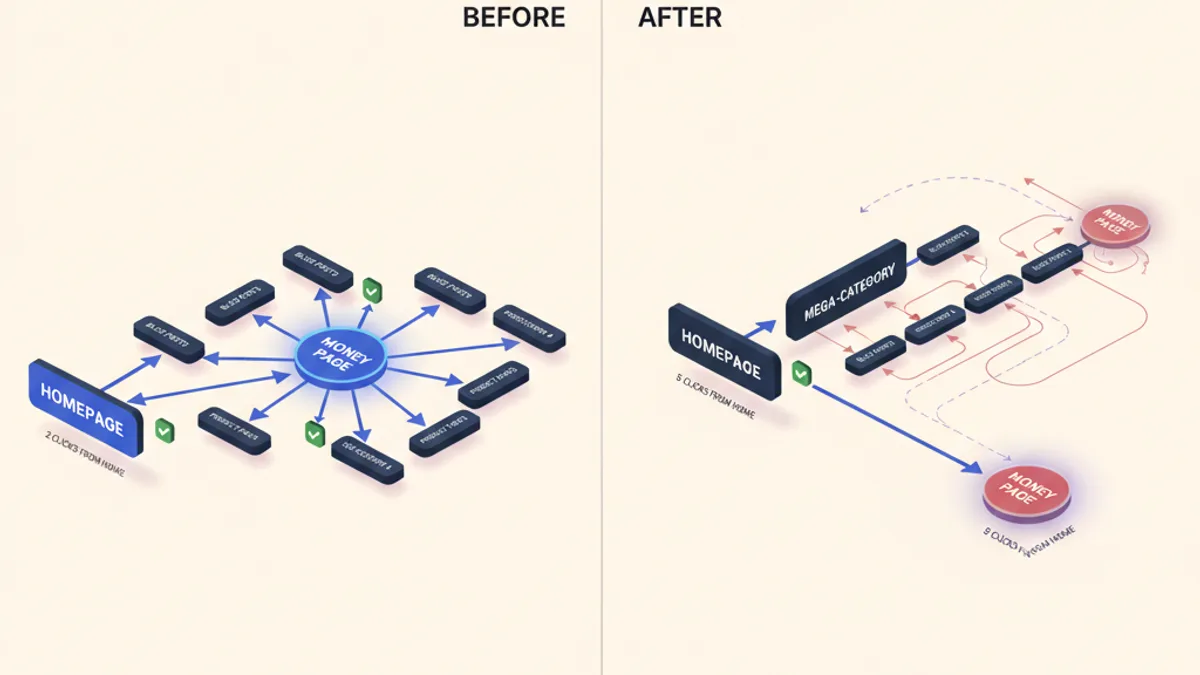
I have watched this play out on a migration with a spotless redirect report. Traffic fell for weeks and the team was stumped, because every old URL resolved exactly where it should. (This is the same trap I covered in what to do when rankings drop after a site launch.) The real problem was that the new information architecture had quietly demoted a handful of commercial pages from two clicks off the homepage to buried under a new mega-category. Once we rebuilt the internal links to restore those short paths, rankings came back.
The single safeguard that prevents this is boring and almost never done: before the migration, map the internal link paths that lead to your most important pages, and after the migration, rebuild those exact paths. Not the redirects. The internal links. Treat the redirect plan as table stakes and the architecture plan as the real work.
And when it does go wrong, recovery is not a switch you flip. Google has to recrawl the new structure, re-evaluate it, and re-flow PageRank through the changed link graph. In my experience that runs in weeks, not days, even after you have fixed the internal linking, which is exactly why catching it before launch is worth so much more than fixing it after.
There is a leak detail that makes this concrete. Google's internal documentation, surfaced in the 2024 Content Warehouse leak, shows the system stores a page's change history and, when comparing versions, keeps only the last 20 changes for a URL. Translation: redirecting a page repeatedly, or shuffling content across new URLs without a stable structure, is not free. The link graph has a memory, a point I made the whole case for in SEO can't erase what Google already remembers.
THE RISK
When Google Devalues a Link: The Uncertainty Rule
Not every link that points at you actually passes equity. A lot of guides still describe link evaluation like it is 2012, all penalties and disavow files. The modern reality is calmer and more ruthless.
The operating principle
If Google cannot be confident a link is a genuine editorial endorsement, the safe move is to give it little or no weight. Not penalize you. Just quietly ignore it. Devalue when uncertain. Once you internalize that, half of the sketchy link tactics on the market stop making sense.
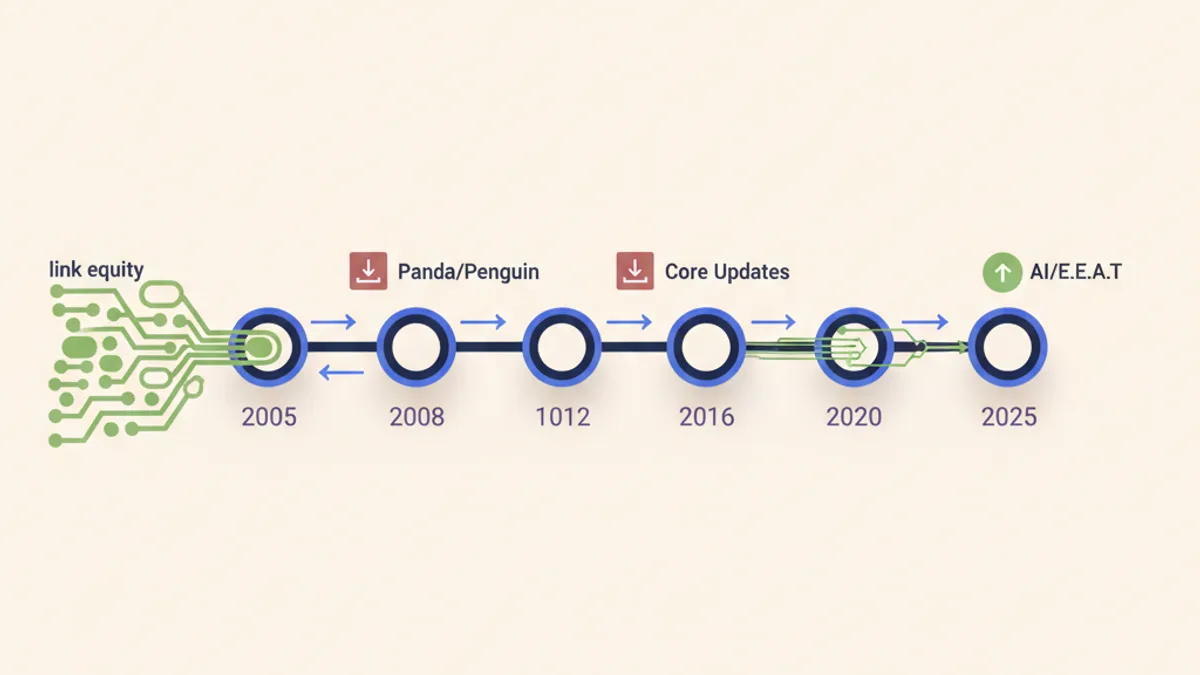
Several algorithm updates over the years steadily tightened this, each one cutting off another way for PageRank to flow through links that should not pass it:
- Nofollow (2005). Google introduced the
rel="nofollow"attribute so site owners could mark links they did not vouch for, like blog comments. Originally it flatly blocked PageRank from passing. - The end of sculpting (2009). Matt Cutts confirmed that nofollow no longer redistributes equity to your other links. More on that in a moment.
- Penguin (2012). The first Penguin update hunted spammy link profiles and demoted the sites that built them. This was the punishing era.
- Penguin 4.0 (2016). The philosophy flipped. Instead of penalizing a site for bad links, Penguin began devaluing those links, treating them as if they were not there. Most spam stopped being a penalty risk and started being wasted effort.
- Sponsored and UGC (2019). Google added
rel="sponsored"andrel="ugc"for paid and user-generated links, and changed nofollow from a hard rule to a "hint." The whole direction of travel is Google deciding, link by link, whether it believes you. - The Link Spam Updates (2021 and 2022). The December 2022 update rolled out SpamBrain, a machine-learning system that neutralizes the value of unnatural links automatically and at scale. The word is neutralize, not punish. I broke down how it spots patterns in how SpamBrain detects manipulative link patterns.
- The August 2025 spam update (the liability era). This may be where Google moved past simply ignoring bad links. In a case study from Sterling Sky, a business lost rankings for the exact keyword patterns that matched its spammy exact-match anchor text, and the links involved were not new. Some were five years old, mostly forum and blog comments with keyword-rich anchors. The tell was referring domains climbing while organic traffic fell, the classic sign that Google has stopped counting a manipulative link profile. The lesson for 2026: aged exact-match anchors built from low-quality links are no longer just dead weight. As the sites hosting them get devalued, the value they once passed unwinds, and a pattern of exact-match anchors can shift from neutral to an active drag on the pages it points at. It is one more reason to keep your anchors varied and natural, which I cover in the anchor text distribution formula, and to think twice before reaching for a disavow file, as I argue in the toxic backlinks myth.
- PageRank sculpting (the lost art). Back when nofollow blocked PageRank, SEOs tried to "sculpt" the flow by nofollowing their own internal links to funnel equity toward money pages. Cutts killed that in 2009: the equity assigned to a nofollowed link now simply evaporates instead of redistributing. So sculpting by blocking links is dead, and most of the industry quietly forgot sculpting entirely.
But that last point is a transition, not an ending, because it points at something real. Sculpting by blocking is dead. Sculpting by architecture, deciding which links exist, where they sit, and what they point to, is alive and well, and it is one of the most underused skills left in technical SEO. The rest of how you control PageRank comes down to that. Start by plugging the leaks.
THE LEAKS
Redirects, Canonicals, and Noindex: Where Equity Leaks
A few technical situations decide whether equity survives or drains. Quick tour.
Redirects. Good news here. For years SEOs believed a 301 redirect bled off a little PageRank. Google's Gary Illyes confirmed in 2016 that 30x redirects no longer lose PageRank. A permanent redirect passes its equity through, which is exactly why reclaiming old URLs is such a cheap win.
Canonicals. When you have duplicate or near-duplicate pages, Google picks one canonical version and consolidates the signals, including PageRank, onto it. Used well, canonical tags concentrate equity. Used carelessly, they strand authority on a page you did not mean to promote.
Noindex. This one is murkier, and even Googlers have given mixed answers. The working understanding is that a page marked noindex will, over time, be treated as noindex, nofollow, and its links eventually stop passing value. Routing important internal links through noindexed pages is a slow leak.
The theme across all three: equity is conserved when paths are clean and consolidated, and it drains when you send it through dead ends.
THE DEBATE
Are Links Dead? A Quick Word on Links vs Mentions
Short answer: no. The "links versus mentions" debate usually confuses two things that work at different levels. A link is a document-level signal. It points at a specific URL and passes PageRank to that page. A brand mention is closer to a site-level or entity-level signal. It helps Google understand who you are and how trusted you are, but it does not hand a specific page the targeted authority a real link does. (Entity SEO is the deeper story on the mention side.)
So a flood of mentions will not push one product page to the top the way a few strong, relevant links to that exact page will, and a great backlink profile will not make Google trust your brand if nobody ever talks about you. You want both, aimed at the right level: links to the pages you need to rank, mentions to build the brand trust that makes those links easier to earn.
That distinction deserves a full article of its own, and it is getting one. For PageRank, the point that matters is simple. Links still carry the targeted authority, and that is what the rest of this guide is about.
THE EVIDENCE
The 2024 Leak: What Modern PageRank Looks Like
Most of what we now know with confidence comes from Google's own internal documentation, which spilled into public view in March 2024 when the Content Warehouse API docs were accidentally published. Mike King at iPullRank did the definitive breakdown, and I wrote up what it means for the rest of us in the Google algorithm leak changed everything. The picture it paints of PageRank is richer than the single number from the old toolbar.
| Leaked attribute | What it appears to be |
|---|---|
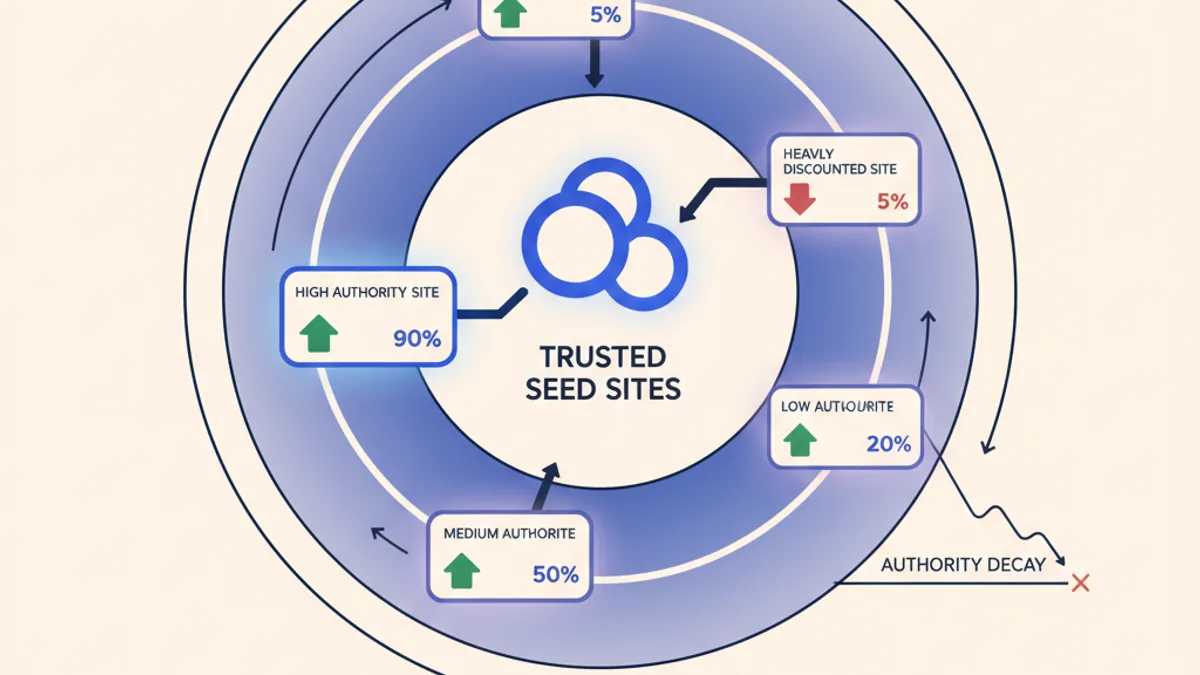
pagerank_ns | PageRank-Nearest Seeds. The modern, seed-based version that discounts a page's PageRank based on how far it sits from a set of trusted seed sites. |
rawPagerank | A base PageRank value before adjustments. |
firstCoveragePagerank | A PageRank value captured when Google first discovers a page. |
homepagePagerankNs | Your homepage's PageRank, attached to other pages as a stand-in until each earns its own. New pages borrow the homepage's strength at birth. |
siteAuthority | A site-wide authority score. Google denied having one for years. The documentation says otherwise. |
fullLeftContext / fullRightContext | The words stored on each side of a link. Google reads the sentence around your link, not just the anchor. |
anchorMismatchDemotion | A demotion applied when a link's anchor and context do not match the topic of the page it points to. |
Two of these deserve a closer look, because they confirm things the rest of this article has been building toward.
First, Nearest Seeds is a discount, not a bonus. It is easy to read "distance to trusted seed sites" and picture points being added for proximity. The cleaner way to think about it is the inverse: it works like a decay or discount factor applied to distance. A page sitting right next to the trusted seed set keeps almost all of its raw PageRank. The further a page drifts from those seeds across the link graph, the more its PageRank gets discounted. So distance from trusted sources behaves like a penalty multiplier on the equity a page would otherwise have, which is why a link from a site one hop from the New York Times is worth so much more than the same link from a site lost in the long tail. It rewards real links and a recognizable brand at the same time, because both pull you closer to the seeds.
Second, the left and right context fields confirm the reasonable surfer multiplier, this time for the text around a link. Google stores the words on each side of a link in fullLeftContext and fullRightContext, plus a paragraph-level hash of the nearby terms. There is also an anchorMismatchDemotion for links whose anchor and surroundings do not match where they point. Put those together and you get a hard conclusion. An irrelevant link does not merely fail to help. It can pass less PageRank, or get actively demoted, because the surrounding context tells Google the link does not belong.
From the leak, in plain terms
Google reads the anchor, the words around it, the topical fit of the linking page, and your overall anchor mix. Write the link the way a journalist cites a source and keep the whole paragraph on topic. I wrote the full playbook in how to build backlinks that pass PageRank.
You do not get to see any of these numbers. There is no toolbar coming back. But knowing they exist changes how you act. New pages launched on a strong site get a head start. Site-level authority is real and worth building, a theme I keep returning to in how Google's AI measures trust and expertise. And the system is clearly per-document and per-site at the same time, which is exactly why the links-versus-mentions framing above matters.
THE PLAYBOOK
How to Improve the PageRank You Control
Enough theory. Here is what actually moves the number, ordered by how much control you have.
- Fix your internal links first. This is the highest-leverage, lowest-cost work in SEO and almost nobody does it well. Map which of your pages are strong, then add contextual links from those pages down to the pages you need to rank. Pull your money pages closer to the homepage. Kill orphan pages. You already paid for this equity by earning the backlinks. Routing it correctly is free, and it is the heart of technical SEO done right.
- Reclaim broken equity. Because 301s now pass full PageRank, dead pages on your site that still have backlinks are leaking money. Find your 404 pages that have links pointing at them and redirect each one to the most relevant live page. Those links already exist. Right now they count for nothing.
- Earn relevant links to specific pages. Not your homepage by default, and not your easy blog posts only. The pages you most need to rank are usually the hardest to attract links to, which is exactly why internal linking from your linkable assets matters so much. Earn links to the strong stuff, then route that authority internally to the commercial pages.
- Build the brand mentions that raise site authority. Digital PR, original data, expert commentary, the work that gets you named even without a link. This feeds the site-level trust signals the leak revealed.
Notice the order. Internal links and reclaimed redirects are things you can do this week, on your own, with no outreach. External links and brand building are the longer game. Most sites have a backlog of unspent equity sitting in bad internal structure, and they go chasing new links before they have routed the equity they already own. Do not be that site.
THE TOOLS
How Do You Measure PageRank Now?
You cannot measure Google's real PageRank. The public toolbar score is gone and nothing replaced it. The closest public stand-in is Open PageRank, a free tool that rebuilds a PageRank-style score from open web crawl data on a 0 to 10 scale. It is genuinely useful as a rough domain-strength gauge, but be clear about what it is not:
- It is not user friendly on the surface. It is built for bulk lookups and an API, so you paste in a list of domains or query it programmatically rather than getting a polished, guided report.
- It is not guarded against manipulation. Because it is computed from an open link graph with a transparent method and no spam layer, the score can be inflated by exactly the kind of low-quality links Google would ignore or neutralize.
- It does not calculate any of the factors Google has nested into its own version. There is no seed-distance discounting, no
siteAuthority, no reasonable-surfer weighting, no spam neutralization. It is raw link-graph PageRank, not Google's PageRank.
So treat it as a directional gauge, not the real thing. The same caution applies to the commercial metrics, each of which measures something slightly different:
| Metric | Level | Best used for |
|---|---|---|
| Open PageRank (DomCop) | Domain | A free, raw, link-graph score. Rough and gameable, but free at scale. |
| URL Rating (Ahrefs) | Page | The closest analog to classic PageRank. Accounts for internal and external links to a single page. |
| Domain Rating (Ahrefs) | Domain | Sizing up a whole site's backlink strength. |
| Domain Authority (Moz) | Domain | A second domain-level opinion, widely quoted in outreach. |
| Authority Score (Semrush) | Domain | Blends link power, traffic, and spam signals into one number. |
None of them is Google's actual PageRank. For diagnosing equity flow inside your own site, a page-level metric like URL Rating will tell you far more than any domain-level score.
FAQ
Frequently Asked Questions
Is PageRank still used in 2026?
Yes. The public toolbar score was retired in 2016, but Google representatives have repeatedly confirmed that PageRank remains part of the core ranking system, and the 2024 leak shows multiple PageRank variants still stored internally.
How does PageRank work?
PageRank works by treating links as votes. A page passes a share of its authority to the pages it links to, that authority is split across all of its outbound links, and pages that collect more votes from more trusted pages rank higher. A modern, seed-based version of this still runs inside Google.
How does PageRank flow through a website?
Equity enters through external links, usually concentrating on your homepage and top pages, then flows internally through your links, splitting across each page's outbound links and decaying with distance. Internal linking is how you direct that flow to the pages you want to rank.
What is the damping factor, and is it the same as the random surfer?
No, they are separate. The random surfer is the conceptual model of a user clicking links at random. The damping factor, usually 0.85, is the probability that the surfer keeps clicking rather than jumping to a random page. It exists to stop authority from getting trapped in loops and to let the math settle on stable scores.
What is the reasonable surfer model?
It is a Google patent stating that not all links are equally likely to be clicked, so a link passes authority in proportion to its click probability. Position, prominence, anchor text, and topical relevance all act as multipliers, which is why a relevant in-content link outweighs a footer or off-topic link.
Are backlinks still a ranking factor?
Yes. Google has tested removing link signals internally and found results got noticeably worse. Links still matter. What changed is that low-quality or suspicious links are increasingly ignored rather than counted.
Is link building dead, or are mentions replacing links?
Neither replaces the other. Links pass PageRank to specific pages, a document-level signal. Mentions build brand and entity trust, a site-level signal. You want both, aimed at the right level.
How do I check my PageRank?
You cannot see Google's real score. Use proxies instead: Open PageRank or URL Rating for page and domain strength, Domain Rating or Domain Authority for site-level strength, and Authority Score for a blended view. Treat all of them as directional.
THE BOTTOM LINE
The Bottom Line
PageRank never died. It went quiet, got smarter, and moved behind the curtain. The teams that win in 2026 are not the ones chasing a number they can no longer see. They are the ones who understand that link equity is a flow, that their own architecture is the plumbing, and that a migration or a sloppy internal structure can strand authority they already paid to earn.
Get the external links, yes. But before you spend another dollar on outreach, walk your own site and ask one question: is the equity I already have actually reaching the pages that make me money? For most sites the answer is no, and fixing that is the cheapest growth you will find all year.
If you want a second set of eyes on how equity moves through your site, that internal-link and migration mapping is exactly the kind of work we do in our technical SEO engagements, and it is often the first thing we check in a penalty recovery. Either way, get in touch and go route your water to the right rooms.
Sources
- Brin, S. and Page, L. (1998). The Anatomy of a Large-Scale Hypertextual Web Search Engine. Stanford.
- PageRank. Wikipedia (formula, Google matrix, and convergence).
- US7716225B1, Ranking documents based on user behavior and/or feature data (the Reasonable Surfer patent). Google.
- Evolving nofollow, new ways to identify the nature of links. Google Search Central.
- Spam policies: link spam. Google Search Central.
- King, M. (2024). Secrets from the Algorithm: Google Search's Internal Engineering Documentation Has Leaked. iPullRank.
- Hawkins, J. (2026). How Google's August 2025 Spam Algorithm Update Impacted Local SEO. Sterling Sky.
- Open PageRank. DomCop.